
How to Read a 3-Card Tarot Spread (Past, Present, Future)
Learn the classic 3-card tarot spread step by step — shuffle, draw, read each position, weave the three together. Worked example using Rider-Waite-Smith.
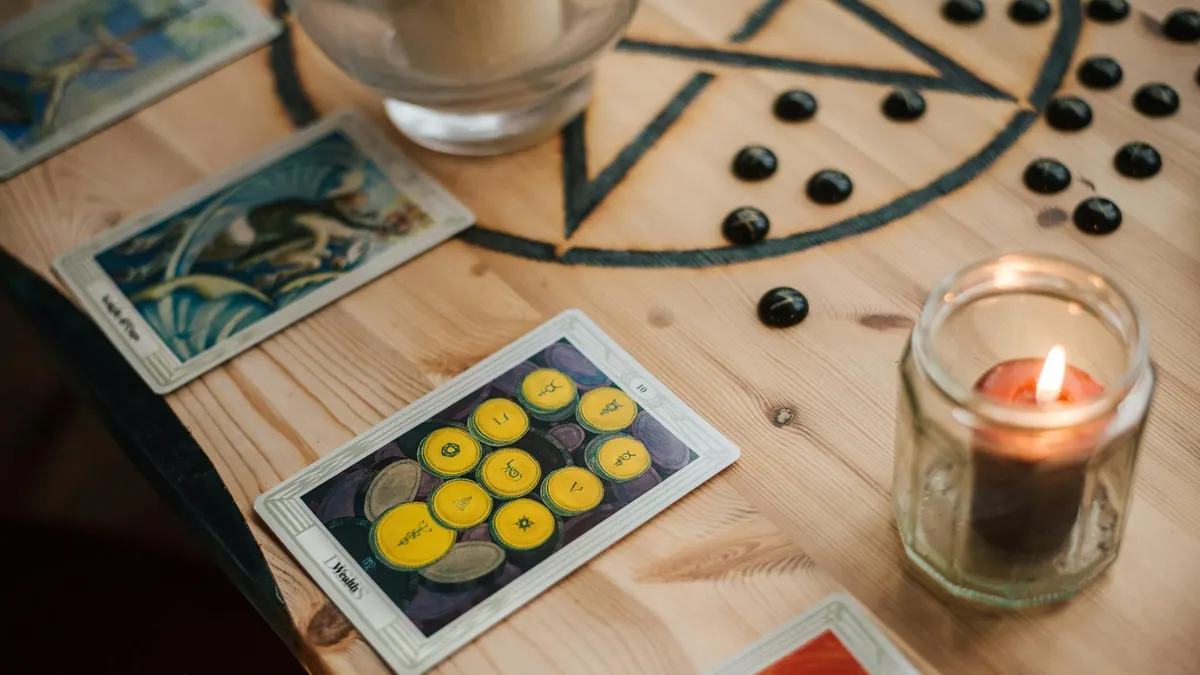
The 3-card tarot spread is the most-taught spread in modern tarot — a small enough draw to be intimate, a large enough one to tell a story. The classic layout reads Past / Present / Future, but the same three positions can be remapped for almost any question. This guide walks through how to read one cleanly, with a worked example from a Rider-Waite-Smith deck.
If you want to actually do a 3-card spread right now in your browser — shuffle, focus, pick three from a face-down deck — our free 3-card tarot spread tool does the math, the deck stays in your browser, and your question never reaches our servers.
What is a 3-card tarot spread?
A 3-card tarot spread is a reading in which three cards are drawn from a shuffled deck and read in sequence. The most common layout is Past / Present / Future — the first card reflects what you carry from the past, the second names the present moment, the third points toward where you are moving. Each card is read in its position, then woven together.
It is the smallest spread that still tells a story. One card is a snapshot; three is an arc.
The Past / Present / Future layout
Three cards, laid left-to-right:
- Past — what is closing, what you bring, the foundation under the question
- Present — the moment as it actually is, including what you might be avoiding
- Future — the direction of motion, not a fixed outcome
The third card is the most commonly misread position. The tradition does not treat it as fate. It reads it as trajectory — the direction things are pointing if nothing changes. A “Future” Death card doesn’t mean someone dies; it means a major ending is on the horizon if the present pattern continues.
How to shuffle and draw
The classical sequence:
- Settle the question. Specific beats vague. “Should I take this offer?” reads better than “What’s next for me?”
- Shuffle. Hold the question in mind. Shuffle however feels right — overhand, riffle, washing the deck on a flat surface. Most practitioners shuffle until something says stop.
- Cut the deck. Optional but traditional. Cut with the non-dominant hand, restack in any order that feels right.
- Draw three cards from the top. Lay them face-down left to right.
- Turn them over one at a time, in order. Each card is read fully before turning the next.
A worked example
Question: “Should I leave this job?” Cards drawn from a Rider-Waite-Smith deck:
- Past: Eight of Pentacles
- Present: Five of Cups
- Future: The Star
Reading:
- The Eight of Pentacles in Past is the apprentice at the bench — long, focused, repetitive work. The querent has been craftspersoning. The current job has taught them something.
- The Five of Cups in Present is the figure mourning three spilled cups, with two upright behind them. The reading: the querent is focused on what’s been lost or disappointing, less aware of what is still standing.
- The Star in Future is hope after the storm — the woman pouring water under the open sky. The card reads as renewal, possibility, faith returning.
The arc: years of focused work brought you here; the present grief is real but partial; the trajectory, if you can lift your gaze, is renewal. The reading doesn’t tell the querent to leave or stay. It says: notice that two cups are still standing.
Other 3-card layouts to try
The same three positions remap into other readings depending on the question:
- Situation / Action / Outcome — for a decision in front of you
- Mind / Body / Spirit — for a state-of-self check-in
- Strength / Weakness / Advice — for a project or relationship audit
- You / Them / The relationship — for a relational reading
- What I know / What I don’t know / What I need to know — for stuck questions
The deck doesn’t change; the lens does.
Reading the three together
A 3-card reading isn’t three separate one-card readings. The reader’s craft is in the synthesis — what story do the three cards tell together?
Watch for:
- Repeated suits. Three cups = deeply emotional question. Three wands = action-oriented. Three pentacles = material. Three swords = mental.
- Repeated numbers. Three 5s = upheaval theme. Three 10s = completion theme.
- Mostly major arcana (more than one) = archetypal, life-shaping moment. Mostly minor = day-to-day texture.
- Reversals. Two or more reversed cards = shadow work; the reading is asking you to look at what you don’t want to see.
The synthesis is where the reading lives. Without it, you have three flashcards. With it, you have an arc.
Mistakes that flatten a reading
The five most common beginner missteps:
- Asking yes/no questions. The tarot is built for “what is the texture of…” — not for binary outcomes. Reframe yes/no questions to ones the cards can answer.
- Reshuffling when you don’t like the answer. This turns the spread into a slot machine and destroys the practice.
- Reading card-by-card without the synthesis. The arc is the reading.
- Ignoring reversals. Even if your tradition doesn’t read reversals, notice when one shows up — the universe has a sense of humour about your protocol.
- Treating the Future card as fate. It’s trajectory, not verdict.
If you’re new to tarot more broadly, our Tarot for beginners guide covers the 78-card structure, how to choose a deck, and how to set up a daily practice. If you’ve drawn The Tower in a recent spread and want to know what it means before you panic, our Tower card meaning guide walks the upright and reversed reading.
A note on framing: a 3-card spread is offered here as a reflective practice, not a predictive tool. The cards don’t determine what happens. They surface the patterns you might otherwise miss.
Questions about this
Do I have to use Rider-Waite-Smith for a 3-card spread?
No. Any tarot deck with 78 cards (22 major arcana + 56 minor) works. Rider-Waite-Smith is the most widely-cited deck because its imagery is the reference point for most modern interpretation guides — beginners often find it easier. But a Marseille deck, Thoth deck, or any modern deck reads the same way structurally.
Should I reshuffle if the cards feel wrong?
No. Part of the practice is sitting with what came up, including discomfort. Reshuffling because you don't like the cards turns the reading into a slot machine. If the spread truly doesn't speak to your question, shuffle again and ask a different question — but don't keep drawing the same one.
How often can I do a 3-card reading?
Most practitioners recommend one spread per question. Doing the same question repeatedly produces noise more than insight. If a new question arises (a different decision, a different relationship), shuffle again. If the same question keeps surfacing, that's usually the signal to sit with the original spread longer, not draw new cards.
What if I get a card I don't know?
Look it up. Every card has documented upright and reversed meanings in the tradition. Start with the image — what catches your eye? Then read the card's accepted meaning. Over time the image and the meaning fuse, and you'll recognise the card on sight.
Can I do a 3-card spread for someone else?
Yes, and it's how many practitioners learn fastest. The reader shuffles; the querent (the person asking) cuts the deck and picks three cards. The reader interprets, but the querent's own reaction often surfaces the truest meaning. Be careful with claims — frame readings as reflective, never predictive.
For reflection — not a prediction. Full disclaimer.