
Tarot for Beginners: Where to Start
Beginner's guide to tarot — the 78-card deck (major + minor arcana), how to choose your first deck, building a daily practice, reading upright and reversed.
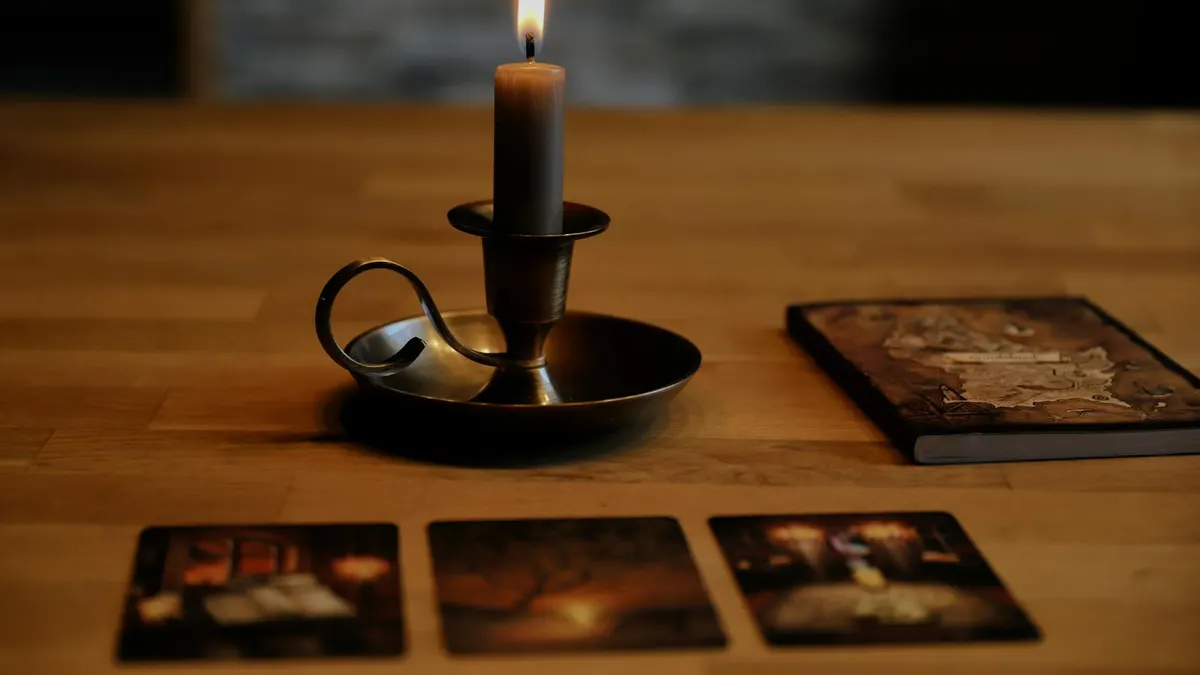
Tarot looks intimidating from the outside: 78 cards, two arcana, reversed meanings, dozens of layouts, centuries of tradition. From the inside, it’s quieter than that. The beginner’s path is short, well-marked, and built around one practice: sit with a card a day.
This guide covers what tarot is, the structure of the 78-card deck, how to choose your first deck, and how to start a daily practice that compounds. If you want to start drawing immediately — same card all day, fresh tomorrow — our free Daily Tarot tool runs in your browser using the full Rider-Waite-Smith deck.
What is tarot?
Tarot is a 78-card system used since 15th-century Italy — originally a card game, later (from the 18th century) adopted as a tool for divination and reflection. The modern reading practice draws on the Rider-Waite-Smith deck (1909) by Pamela Colman Smith and A.E. Waite, whose imagery anchors most contemporary interpretation guides.
The deck is read as a language. Each card carries documented meanings; the reader’s craft is in choosing which meaning fits the moment.
The 78-card structure
Two arcana, ordered by depth of theme:
- Major Arcana — 22 cards, numbered 0 to XXI. These carry archetypal, life-shaping themes — The Fool’s journey of becoming, The Lovers’ choice, Death’s necessary endings, The Star’s renewal. When several major arcana show up in a spread, the reading is about something large.
- Minor Arcana — 56 cards, four suits of 14 each. These cover daily-life textures — emotion (Cups), action and passion (Wands), material life and craft (Pentacles), thought and conflict (Swords). Each suit runs Ace through Ten, then four court cards: Page, Knight, Queen, King.
Most readings draw from both arcana. A spread of mostly minor arcana points to the texture of the day; mostly major points to a turning point.
How to choose your first deck
The most-recommended beginner deck is the Rider-Waite-Smith (RWS) — the deck Pamela Colman Smith illustrated in 1909. Three reasons:
- Most interpretation guides assume RWS imagery. When a book says “the figure in the Eight of Pentacles is hunched over their work,” they’re describing Smith’s illustration. Using a different deck means doing translation in your head.
- Public domain. The deck entered the public domain in 2021 (US and UK; life of author + 70 since Smith died in 1951). You can find it freely; many reproductions are very cheap.
- It is what we use. Our Daily Tarot and 3-card spread tools both ship the original RWS imagery from Wikipedia Commons.
Other widely-used beginner decks:
- Tarot de Marseille — older European tradition, more abstract pip cards. Steeper learning curve; more historical depth.
- Thoth deck (Crowley / Harris) — densely symbolic, beautiful, demanding. Most readers grow into it rather than start with it.
- Modern indie decks (The Wild Unknown, Modern Witch, Light Seer’s, etc.) — often beautiful, but the illustrations sometimes differ from RWS conventions, which can confuse a beginner consulting RWS-keyed guidebooks.
If in doubt: start with RWS. Move to another deck once the language is in your bones.
Building a daily practice
The fastest learning path is one card a day. The structure most practitioners settle on:
- Shuffle in the morning. Hold a loose question or open prompt — “What is today asking of me?” works.
- Draw one card. Look at the image before you read any text. What catches your eye? What’s the figure doing? What’s the weather?
- Sit with your own read for a minute. Trust your associations.
- Then look up the card in a beginner guide (Rachel Pollack’s Seventy-Eight Degrees of Wisdom, Mary K. Greer’s Tarot for Your Self, or any RWS-aligned book). Notice where your read aligned with the tradition and where it didn’t.
- Carry the card through the day — not as a prediction, but as a lens.
- Re-visit before sleep. Did anything from the card show up?
Three months of this and you’ll recognise most cards on sight. Six months and you’ll start reading spreads fluently.
A daily practice tool with consistent seeding lives at /tarot-daily/ — the same card stays with you all day, fresh tomorrow, and you can write your focus question alongside the card.
Reading upright vs reversed
Half of the cards in any draw will land reversed (upside down). Practitioners handle this two ways:
- Read reversals as a separate meaning. Most modern guides give each card both an upright reading (the card’s gift, expression, fulfilment) and a reversed reading (the gift blocked, the shadow side, the work). This is the dominant approach.
- Read all cards upright. Some practitioners ignore reversals entirely, on the principle that a card holds its full range whichever way it lands. This is a minority view but defensible.
If you’re starting out, learn the upright meanings first. Add reversals once the 78 uprights are familiar — usually 3 to 6 months in.
Reading for yourself vs others
Most practitioners learn by reading for themselves daily — it’s the lowest-friction practice and you have the inside view on whether the reading lands. Reading for others requires more care:
- Frame every reading as reflective, not predictive. “The cards suggest…” not “you will…”
- Don’t make medical, legal, financial, or fertility claims. These are off-limits per the tarot ethics most modern readers follow.
- Let the querent talk. Their reaction often surfaces the meaning faster than your interpretation.
- End with what’s actionable. A reading that says “this is what’s happening” without “and here’s what you can do” leaves the querent stuck.
Common beginner mistakes
The patterns that flatten a new practice:
- Drawing more cards when you don’t like the first one. Practise sitting with what came up.
- Memorising before sitting with the image. Image first, text second.
- Over-reading for catastrophe. The Tower, Death, the Three of Swords — the “scary” cards are about necessary change, not doom. (Our Tower card meaning guide walks through exactly this.)
- Treating the practice as prediction. The tarot’s deepest gift is reflection. Prediction is a side effect, not the point.
When you’re ready for your first multi-card draw, our 3-card spread guide walks the classic Past / Present / Future layout step by step.
A note on framing: tarot is offered here as a reflective practice grounded in the public-domain Rider-Waite-Smith tradition, not as a predictive tool. The cards don’t decide what happens. They surface what you might otherwise look past.
Questions about this
Do I need any psychic ability to read tarot?
No. Reading tarot is a literate practice — like reading poetry. You learn the symbols, you sit with the images, and you let your own associations join the tradition's. The skill is recognition and synthesis, not extrasensory perception. Anyone willing to spend time with the deck can learn to read it.
Do I need to 'cleanse' or 'consecrate' my deck?
Practitioners vary. Some smoke-cleanse with sage or palo santo, some leave the deck under a full moon, some shuffle thoroughly before first use. None of this is required by the tradition itself — A.E. Waite's original guidance didn't include rituals. Do whatever helps you treat the deck as meaningful. The deck doesn't 'mind' either way.
How long does it take to learn tarot?
Most practitioners read confidently within 3–6 months of daily practice. The 22 major arcana can be learned in 2–3 weeks of one-a-day study; the 56 minor arcana take longer because the suits + numbers compound (4 × 14 = 56 unique cards). Reading well — synthesis, intuition, comfort with reversals — takes years.
Should I memorise all 78 card meanings?
Eventually, but don't lead with memorisation. Lead with the image. Look at the card, notice what catches your eye, build your own association — then check it against the tradition. Memorisation alone produces flashcard reading; image-first reading produces fluent reading.
Is tarot the same as fortune-telling?
Historically they overlap, but most modern practitioners frame tarot as a reflective practice rather than predictive. The cards surface patterns, prompt questions, externalise inner knowing — they don't decide what happens. Treating tarot as fortune-telling tends to flatten the practice; treating it as a mirror tends to deepen it.
For reflection — not a prediction. Full disclaimer.