
The Tower Tarot Card Meaning (RWS) | Explain Fate
The Tower (Major Arcana XVI) in Rider-Waite-Smith tarot — upright and reversed meanings, position interpretations, and why this card scares people more than it should.
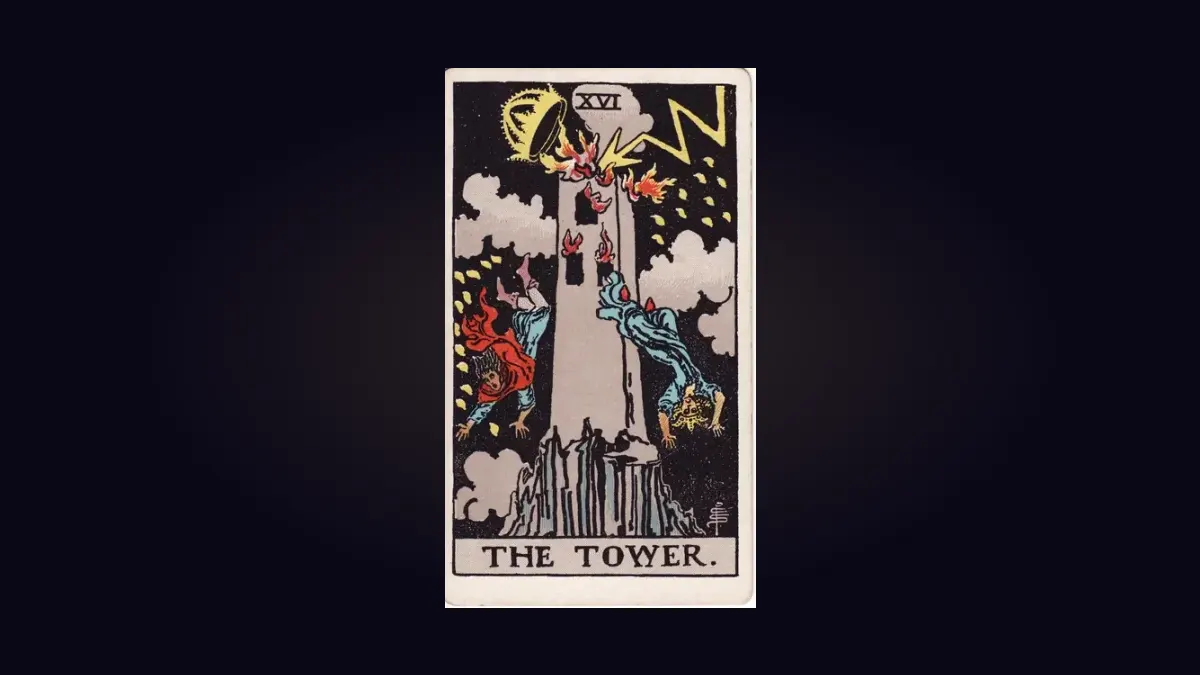
The Tower is the sixteenth card of the Major Arcana — and the most visually dramatic card in the Rider-Waite-Smith deck. Lightning striking a stone tower, flames at the top, a crown blown free, two figures falling. It is also one of the most consistently misread cards in modern tarot.
If you’ve drawn The Tower in a recent reading and want to know what it actually means before you panic, this guide walks the upright and reversed reading, the position-specific interpretations, and why the card is more friend than enemy. (For context on the wider deck, our Tarot for beginners guide covers the 78-card structure. To do an actual draw, our Daily Tarot tool ships the full Rider-Waite-Smith deck.)
What does The Tower mean in tarot?
The Tower (Major Arcana XVI) in Rider-Waite-Smith tarot reads as sudden upheaval — the collapse of a structure built on false foundations, often experienced as shock or crisis, but ultimately liberating. The card is associated with revelation, awakening, truth breaking through illusion, and the necessary destruction that clears space for what comes next.
It is dramatic but not destructive in the malicious sense. What falls in a Tower draw was always going to fall.
The image — what’s actually on the card
Pamela Colman Smith’s 1909 illustration packs more symbolism into one card than almost any other in the deck:
- A tall stone tower struck by a bolt of lightning from a dark sky
- Flames consuming the top of the tower
- A crown blown clear of the tower’s peak — read by Waite and later commentators as false authority, false certainty, being cast off
- Two figures falling head-first from the tower’s windows — read as the ego or the conscious self being thrown clear of the structure
- Twenty-two yods in the sky around the tower — small flame-shaped objects representing the letters of the Hebrew alphabet, signifying divine presence or revelation
- A mountain peak base — the tower built on stone, but stone isn’t enough when the structure itself is wrong
Smith was a practising Golden Dawn member when she drew the deck; the symbolism is deliberate and dense.
The Tower upright
The upright Tower carries themes the tradition treats as terminal: change is happening, not pending.
- Sudden upheaval — the moment something gives way. Not the slow erosion; the moment of fall.
- Revelation — truth breaking through; the lightning strike as illumination. What you’ve been pretending not to know becomes impossible to ignore.
- Necessary destruction — the structure had to come down. The Tower never represents collapse of something whole; it represents collapse of something already false.
- Liberation through loss — what you lose in a Tower moment is usually what you were paying to keep up. The cost of the structure was higher than the cost of its falling.
- Awakening — the figures falling are not dying. They are being thrown clear.
A.E. Waite’s Pictorial Key to the Tarot (1910) describes the card simply: “Misery, distress, indigence, adversity, calamity, disgrace, deception, ruin.” But Smith’s illustration carries more nuance than Waite’s text — most modern readers (Rachel Pollack, Mary K. Greer) read the card as liberating despite its imagery.
The Tower reversed
The reversed Tower is the same energy held at the threshold:
- Avoiding necessary change — the structure is shaking but you’re shoring it up
- Internal upheaval — the collapse is happening on the inside, hidden from others
- Fear of change — the lightning is closer than you want to admit
- A near-miss — the disaster you feared didn’t happen this time
- Postponing the inevitable — the Tower is patient; it will return
Most reversed Tower readings are about delay rather than escape. The card reads the same direction either way; reversal just changes the timing.
The Tower in spread positions
In a Past / Present / Future spread (see our 3-card spread guide) the card reads differently in each slot:
- Past: an upheaval you’ve already lived through. What fell allowed what is now. Frequently a reading of relief — yes, that was rough; you came through.
- Present: something is collapsing right now. The work is to let it. Shoring up what isn’t true is exhausting; the card invites you to step out of the tower while the lightning strikes.
- Future: a shake-up is in the trajectory. Not fate — direction. The question becomes: how do you want to meet it? Tower energy met consciously hurts less.
In other layouts:
- Love position: truth surfacing, often painfully. Honest reckoning available if both partners can stand the shock.
- Career position: structural collapse — a role, a company, a path. Frequently the job you were already leaving in your head.
- Outcome position: an ending you can’t soft-pedal. The card asks you to be ready rather than resistant.
- Advice position: “stop holding it up.” The Tower as advice usually means letting something fall on purpose.
Why The Tower scares people (and why it shouldn’t)
The card scares people for visual reasons. It’s the only card in the Major Arcana that depicts actual violence — fire, lightning, falling figures, blood (in some printings). Combined with the cultural association of falling towers with disaster, the imagery does its own work on a beginner.
But the tradition’s deeper reading is consistent across teachers:
- The Tower never strikes a true thing. What’s solid stays. What’s a façade falls. The card is correctional, not punitive.
- The figures are thrown clear, not crushed. Smith’s illustration deliberately shows the figures separating from the tower in mid-air. They survive.
- The yods in the sky are divine presence. The collapse happens with witnessing, not in malice.
- What comes next is The Star (XVII). In the Major Arcana sequence, the card immediately following The Tower is The Star — hope, renewal, faith returning. The order is not accidental. (See the Star card meaning for the full reading of the card that answers The Tower.)
Read this way, the Tower is one of the kinder major arcana — uncomfortable but ultimately healing. It is often paired with the Death card meaning (XIII) as the deck’s two endings: Death names the slow, recognised completion you can feel coming; The Tower names the sudden collapse of something built on false ground.
How to work with a Tower draw
When the card shows up in a reading you actually care about:
- Resist the urge to soften it. The Tower wants to be acknowledged, not minimised.
- Ask which structure. Sometimes the answer is obvious. Sometimes the card is naming something you haven’t seen yet.
- Notice what you’re shoring up. The energy you’re spending to keep something standing is often the cost the card is asking you to count.
- Let the falling be the action. The Tower’s gift isn’t doing more. It’s stopping the rescue mission.
- Look for The Star. The card’s natural successor is renewal. Whatever clears space comes next.
If you draw The Tower and want to sit with a fuller reading — what’s collapsing, what survives, what comes after — the Daily Tarot tool gives you the card and the traditional interpretation in one place, and you can carry the focus question with you through the day.
A note on framing: tarot is offered here as a reflective practice, not a predictive tool. The Tower is not foretelling disaster. It is naming what you might already be feeling — and inviting you to meet it rather than flee it.
Questions about this
What does the tower card mean in tarot?
The Tower card (Major Arcana XVI) means sudden upheaval — the collapse of a structure built on false ground, the lightning strike that clears space. It is paired with Death (XIII) as the deck's two endings: Death names the slow completion, the Tower names the sudden one. Modern readers treat the Tower as correctional, not punitive — uncomfortable but ultimately healing.
Is The Tower always a bad card?
No. The Tower is dramatic but not bad. It shows the moment something built on shaky ground collapses — which the tradition reads as ultimately liberating. What falls was always going to fall; the card just shows the moment. Many readers come to regard a Tower draw with respect rather than dread, because it clears space for what comes next.
What does The Tower mean in a love reading?
Often a relationship truth surfacing — sometimes painfully. The Tower in love can mean an affair coming to light, a long-suppressed conflict erupting, or a clear-eyed recognition that something hasn't been working. It rarely means the relationship is doomed; it means the version built on illusion is. What survives is more honest.
What does The Tower mean in a career reading?
A sudden professional shake-up — layoffs, redundancy, a project collapsing, an ethics line crossed and surfacing, a forced pivot. The card tends to point at structures that haven't been serving you; the collapse is liberation as much as loss. Sometimes the 'tower' is the job you were going to leave anyway and only now have to.
Is The Tower the most feared tarot card?
It and Death share the title in most surveys, but for different reasons. Death is feared by people new to tarot who take it literally; The Tower is feared by people who know the deck because they understand what it actually means — sudden change, often before you feel ready. Practitioners often respect The Tower more than they fear it.
Can The Tower mean a literal disaster?
Tarot is offered here as reflective, not predictive — we don't read it as predicting literal events. That said, traditional readers do sometimes interpret The Tower as a warning of external upheaval (accident, news, sudden change). Most modern readers treat it as the inner experience of being shaken, regardless of what triggers it.
For reflection — not a prediction. Full disclaimer.