
The High Priestess Tarot Card Meaning (RWS) | Explain Fate
The High Priestess (Major Arcana II) in Rider-Waite-Smith tarot — upright and reversed meanings, positions, and why this card is listening before evidence.
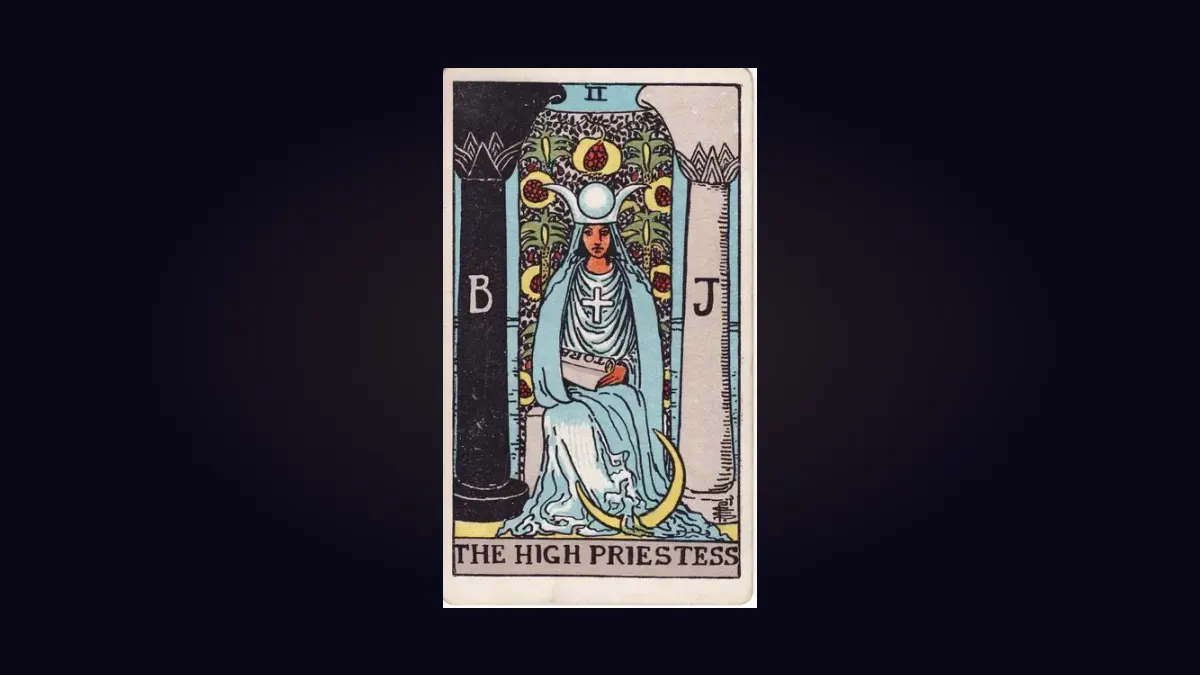
The High Priestess is the third card of the Major Arcana — numbered II, following The Magician — and the deck’s clearest signal to listen before acting. A veiled figure sits between two pillars marked B (Boaz) and J (Jachin), a crescent moon at her feet and a half-hidden scroll in her lap. It is one of the most contemplative cards in the Rider-Waite-Smith deck.
If you’ve drawn The High Priestess in a recent reading and want the full upright and reversed reading along with position interpretations, this guide covers what the card actually means and why it isn’t about psychic spectacle. (For context on the wider deck, our Tarot for beginners guide covers the 78-card structure. To do an actual draw, the Daily Tarot tool ships the full Rider-Waite-Smith deck.)
What does The High Priestess mean in tarot?
The High Priestess (Major Arcana II) in Rider-Waite-Smith tarot reads as intuition, inner knowing, and the wisdom that arrives before it can be explained. The card is associated with the subconscious, sacred silence, mystery held without resolution, and the trust required to act on a knowing that hasn’t yet been proven.
It is the card the tradition treats as the receptive counterpart to The Magician — listening where he speaks, holding where he wields.
The image — what’s actually on the card
Pamela Colman Smith’s 1909 illustration is the deck’s most symbolic interior:
- A veiled woman seated on a throne — the veil itself signals the threshold between conscious and unconscious; what she knows is partially hidden even from herself
- Two pillars marked B (Boaz, severity) and J (Jachin, mercy) — the pillars of Solomon’s temple; the High Priestess sits between the two extremes
- A blue veil stretched between the pillars, decorated with pomegranates — the gateway to the deeper temple; the pomegranates suggest the Persephone myth (knowledge gained through descent)
- A crescent moon at her feet — the lunar cycle as the symbol of intuition; she draws from the moon, not the sun
- A scroll partly visible in her lap, labelled TORA — wisdom partially revealed; the rest is held
- A solar cross on her breastplate — the conscious anchor at the centre of her contemplation
Smith was a practising Golden Dawn member when she drew the deck; the pillar composition is one of the most rigorously Kabbalistic in the deck.
The High Priestess upright
The upright High Priestess carries themes the tradition treats as quietly authoritative:
- Intuition — knowing without evidence; the small voice that arrives before the proof
- Inner knowing — the deeper layer of awareness beneath the chatter
- Sacred silence — the practice of not speaking until the knowing is clear
- Subconscious wisdom — what the rest of you knows before you do
- Mystery without resolution — the willingness to hold a question instead of forcing an answer
A.E. Waite’s Pictorial Key to the Tarot (1910) describes the card as “Secrets, mystery, the future as yet unrevealed” — Smith’s illustration extends this into something more usable: not mystic spectacle, but practical patience.
The High Priestess reversed
The reversed High Priestess is the listening interrupted:
- Ignored intuition — the inner voice has spoken but you’re overriding it
- Overthinking — analysis substituted for knowing
- External validation seeking — asking everyone but yourself
- Kept secrets — sometimes from others, more often from yourself
- Noise — too much input crowding out the quiet signal
Most reversed High Priestess readings are about reception rather than absence. The card reads the same direction either way; reversal just shows the channel obstructed.
The High Priestess in spread positions
In a Past / Present / Future spread (see our 3-card spread guide) the card reads differently in each slot:
- Past: a knowing you’ve been carrying that shaped what came after. Often an intuition you trusted (or didn’t) and the consequence is now visible.
- Present: you already know. The card is asking you to stop searching for confirmation outside yourself.
- Future: a knowing is approaching. Not a forecast — a clarification. The work is to be quiet enough to receive it.
In other layouts:
- Love position: something true but unspoken in the relationship; or a knowing about a connection that you haven’t acted on yet.
- Career position: the gut read on a decision is the right one. The card rarely warns about overthinking — it warns about not trusting what you already sense.
- Outcome position: the answer is being held in the subconscious. Patience is the practice.
- Advice position: “be quiet.” The card as advice almost always means stopping the analysis.
Why The High Priestess isn’t psychic spectacle
The card carries cultural baggage from popular tarot — beginners often imagine a mystical figure with prophetic powers, a fortune teller, a seer who knows what will happen. The cultural shorthand for “intuition” tends toward the dramatic.
But the tradition’s deeper reading is consistent across teachers:
- The High Priestess sits at II, between The Magician and The Empress. Structurally, she is receptive between two more active cards — the listener before the planter.
- The scroll is partly hidden. Smith painted the wisdom as half-revealed deliberately; the card is about holding what isn’t fully resolved, not about magical clarity.
- The pomegranate veil is the Persephone gate. Wisdom in the tradition is gained through descent, not floating above; the High Priestess teaches by entering the underworld, not by hovering.
- The crescent moon at her feet is the cycle, not the prediction. Intuition in this card is rhythmic — it arrives in its own time and shouldn’t be forced.
Read this way, The High Priestess is one of the deck’s most practical major arcana — the card that names the difference between rushing to clarity and earning it through silence.
How to work with a High Priestess draw
When the card shows up in a reading you actually care about:
- Stop seeking outside confirmation. The card almost always means you already know.
- Sit with the question. The High Priestess rewards holding, not resolving. Force tilts the card reversed.
- Notice what arrives in quiet moments. The knowing often comes in the gap between activities, not during them.
- Trust the gut without explaining it. The card asks you to act on a read you can’t yet articulate. The articulation comes later, if at all.
- Listen for the second answer. The first answer is usually surface; the High Priestess is asking for the deeper one underneath.
If you draw The High Priestess and want to sit with a fuller reading — what you already know, what you’ve been avoiding hearing, what answer is waiting — the Daily Tarot tool gives you the card and the traditional interpretation in one place, and you can carry the focus question with you through the day.
A note on framing: tarot is offered here as a reflective practice, not a predictive tool. The High Priestess is not foretelling secret knowledge. It is naming a listening you may already be ready for — and inviting you into the silence.
Questions about this
Is The High Priestess a good card in tarot?
Yes, but it asks for patience. The High Priestess is the deck's clearest signal to listen before acting — which is welcome when you've been forcing, and uncomfortable when you want a decision. Most experienced readers treat it as an invitation to slow down rather than a warning. The card rewards stillness, not speed.
What does The High Priestess mean in a love reading?
An undercurrent in the relationship — something true that hasn't been spoken yet. For singles, often a phase where intuition about a connection matters more than evidence. The High Priestess in love rarely names a meeting; more often it names a knowing that arrives before proof.
What does The High Priestess mean reversed?
Reversed High Priestess usually shows ignored intuition or noise crowding out the inner voice — overthinking, second-guessing, or seeking external validation when the answer is already known internally. The energy is the same; reversal just shows the listening has been interrupted.
What does The High Priestess mean in a career reading?
A phase where intuition outweighs the visible data — a pivot you sense before you can justify, a collaborator your gut likes for reasons you can't fully name, a project worth waiting on. The High Priestess in career rarely warns; more often it asks you to trust the read you already have.
What's the difference between The High Priestess and The Magician?
The Magician is active will — focused action with tools to hand. The High Priestess is receptive knowing — listening before acting. They sit next to each other in the sequence (I and II) deliberately. Most decisions need both: act when the Magician's certainty is appropriate, wait when the High Priestess's knowing is.
For reflection — not a prediction. Full disclaimer.