
The Empress Tarot Card Meaning (RWS) | Explain Fate
The Empress (Major Arcana III) in Rider-Waite-Smith tarot — upright and reversed meanings, positions, and why this card is creative tending of any kind.
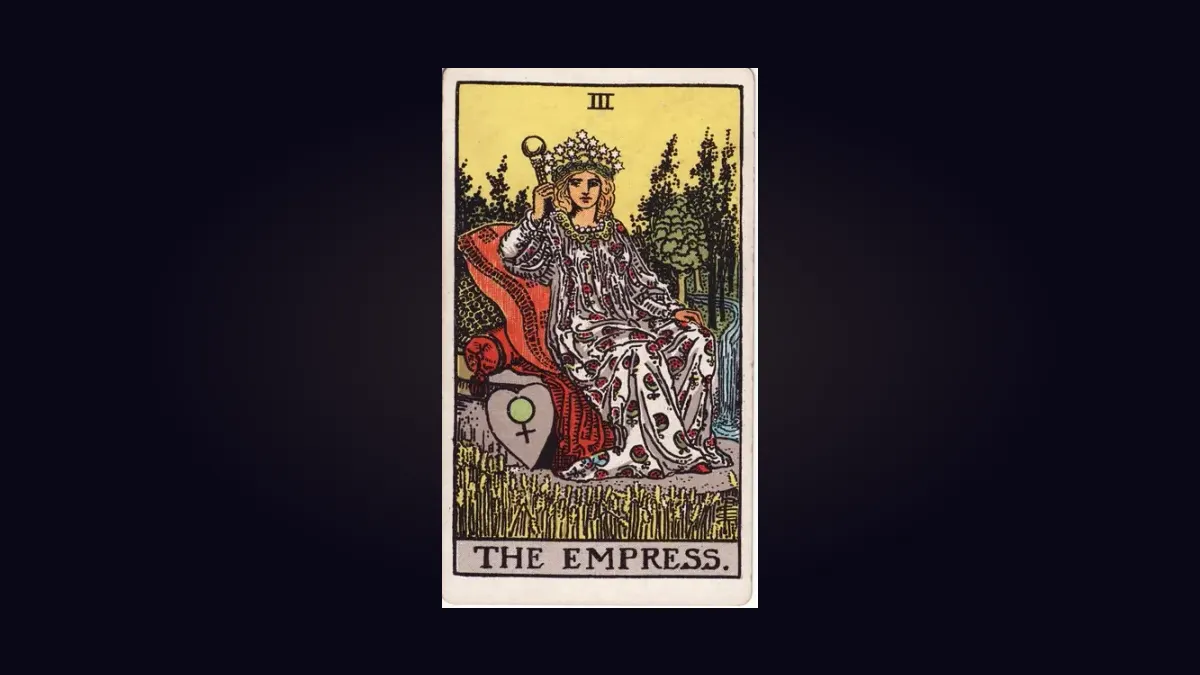
The Empress is the fourth card of the Major Arcana — numbered III, following The High Priestess — and the deck’s warmest signal for creative fertility of any kind. A crowned figure reclines in a field of wheat, surrounded by trees, a stream, and a heart-shaped shield bearing the symbol of Venus. It is one of the most generous cards in the Rider-Waite-Smith deck.
If you’ve drawn The Empress in a recent reading and want the full upright and reversed reading along with position interpretations, this guide covers what the card actually means and why “fertility” rarely means a literal pregnancy. (For context on the wider deck, our Tarot for beginners guide covers the 78-card structure. To do an actual draw, the Daily Tarot tool ships the full Rider-Waite-Smith deck.)
What does The Empress card mean in tarot?
The Empress (Major Arcana III) in Rider-Waite-Smith tarot reads as nurturing creativity, abundance, and the slow growth that follows when something is properly tended. The card is associated with fertility of all kinds — relational, creative, somatic — sensuality without urgency, and the recognition that what wants to come through you needs space rather than force.
It is the card the tradition treats as the first manifest creation — what The High Priestess’s knowing becomes when it takes form.
The image — what’s actually on the card
Pamela Colman Smith’s 1909 illustration is the deck’s most lush composition:
- A crowned woman in flowing robes — relaxed, not enthroned; her power is presence, not display
- A crown of twelve stars — the twelve months, the zodiac, the full year held; her sovereignty is rhythmic
- A heart-shaped shield bearing the symbol of Venus — love as the structural principle of her authority
- A field of wheat at her feet — abundance ripe and harvestable, not just growing
- A stream flowing through the garden — the constant of creative current; the source is moving
- Trees behind her — older life supporting the visible flourishing
- A scepter topped with a globe — generative dominion over what she has cultivated
Smith was a practising Golden Dawn member when she drew the deck; the Venus symbol on the shield, the wheat at her feet, and the relaxed posture together mark the card as creation through ease, not strain.
The Empress upright
The upright Empress carries themes the tradition treats as cleanly generative:
- Nurturing creativity — tending what wants to grow rather than forcing it into being
- Abundance — the felt sense of enough; the recognition that the field is already producing
- Fertility of any kind — relational, artistic, somatic, structural; rarely just literal pregnancy
- Sensuality — pleasure as a creative principle, not a distraction from work
- Slow growth — the patience of the soil; the card never names speed as the right approach
A.E. Waite’s Pictorial Key to the Tarot (1910) describes the card as “Fruitfulness, action, initiative, length of days; the unknown, clandestine; also difficulty, doubt, ignorance” — but Smith’s illustration carries almost none of the darker reading. Most modern readers (Rachel Pollack, Mary K. Greer) read The Empress as creative warmth that doesn’t need to push.
The Empress reversed
The reversed Empress is the nurturing out of balance:
- Creative block — what wants to come through isn’t getting space
- Neglect of self — tending everything but the source
- Smothering — care that has become control
- Dependence — the relationship of nurturer to nurtured has stopped reciprocating
- Depletion — the soil has been overworked
Most reversed Empress readings are about imbalance rather than absence. The card reads the same direction either way; reversal just shows where the generative flow has been interrupted.
The Empress in spread positions
In a Past / Present / Future spread (see our 3-card spread guide) the card reads differently in each slot:
- Past: a chapter of generative warmth that built what came after. Often a relationship, a creative project, or a period of self-tending you’re still benefiting from.
- Present: the conditions for slow growth are live right now. The work is to tend, not to push.
- Future: a generative phase is approaching. Not a windfall — a season of warm, patient creation.
In other layouts:
- Love position: a relationship grounded in mutual tending, or a phase of relational ease. Rarely warning.
- Career position: generative work — building something over time, leading from warmth, body-of-work commitments.
- Outcome position: what you’re tending will grow. The Empress in outcome usually means yes, slowly.
- Advice position: “tend it.” The card as advice almost always means slowing down and caring for what’s already in motion.
Why The Empress isn’t literal pregnancy
The card carries cultural baggage from old tarot tradition — many beginner guides flatten The Empress to “pregnancy” because of the fertility symbolism. Combined with the literal field of wheat and the reclining posture, the card is often misread as a forecast rather than a frame.
But the tradition’s deeper reading is consistent across teachers:
- The Empress sits at III, between The High Priestess and The Emperor. Structurally, she is the first manifest creation — what knowing becomes when it takes form. That form is rarely a child specifically.
- The wheat is the harvest, not the planting. Smith painted the field at the point of ripeness; the card is about reaping what you’ve tended, not about beginning a pregnancy.
- The Venus shield is the structural principle. Venus governs creative warmth across all domains — art, love, beauty, body, friendship. Pregnancy is one application among many.
- The twelve-star crown is the year, the cycle, the rhythm. The card’s authority is rhythmic — not a single event but a season of generative time.
Read this way, The Empress is one of the deck’s most usable cards — the card that asks you to recognise what’s already growing, and to tend it without forcing.
How to work with an Empress draw
When the card shows up in a reading you actually care about:
- Tend the soil. The card almost always means slowing the pace of the work to care for the conditions that allow it.
- Notice what’s already growing. The Empress often arrives when something is further along than you’ve acknowledged.
- Receive as well as give. The reversed reading is about depleted nurturing; balance is the practice.
- Take pleasure in the work. Sensuality in the card means the body’s “yes” — the work shouldn’t feel like dragging yourself through.
- Don’t force the harvest. The wheat ripens on its own schedule. The card’s hardest instruction is patience.
If you draw The Empress and want to sit with a fuller reading — what you’re tending, what’s ready to be harvested, what wants to come through — the Daily Tarot tool gives you the card and the traditional interpretation in one place, and you can carry the focus question with you through the day.
A note on framing: tarot is offered here as a reflective practice, not a predictive tool. The Empress is not foretelling abundance. It is naming a generative season you may already be in — and inviting you to tend it well.
Questions about this
What does the empress card mean in tarot?
The Empress card (Major Arcana III) means abundance, creative fertility, and the tending of something into growth — not just literal motherhood. She rules Venus in traditional correspondences: love, beauty, sensory pleasure, and patient nurturing. Most modern readers treat The Empress as the warmest major arcana and the deck's clearest signal of grounded creative permission.
Is The Empress a good card in tarot?
Yes — it's one of the warmest cards in the deck. The Empress signals abundance, fertility of any kind (not just literal), and the slow growth that comes from proper tending. Most experienced readers welcome it. The card rarely warns; more often it permits.
What does The Empress card mean in a love reading?
A relationship being properly tended — warmth, sensuality, nurturing presence that's mutual rather than one-sided. For singles, often a phase where self-care and openness draw connection. The Empress in love rarely names urgency; more often it names ease.
Does The Empress card mean pregnancy?
Sometimes, but not usually literally. The card's fertility reading covers any kind of creation — a relationship, a project, a body of work, a way of being. Traditional readers do sometimes interpret The Empress as a literal pregnancy when the question is direct, but most modern readers read fertility metaphorically first.
What does The Empress card mean reversed?
Reversed Empress usually shows creative block, neglect of self, or smothering rather than nurturing — the energy of the card turned inward as depletion or outward as control. The energy is the same; reversal just shows where the tending has gone out of balance.
What does The Empress card mean in a career reading?
Slow, generative work — building something that grows over time, tending a body of work, leading from warmth rather than pressure. The Empress in career often shows up when the slow path is the right one and the fast path would burn the soil.
For reflection — not a prediction. Full disclaimer.