
Wheel of Fortune Tarot Card Meaning (RWS) | Explain Fate
The Wheel of Fortune (Major Arcana X) in Rider-Waite-Smith tarot — upright and reversed meanings, positions, and why this card is recognising cycles.
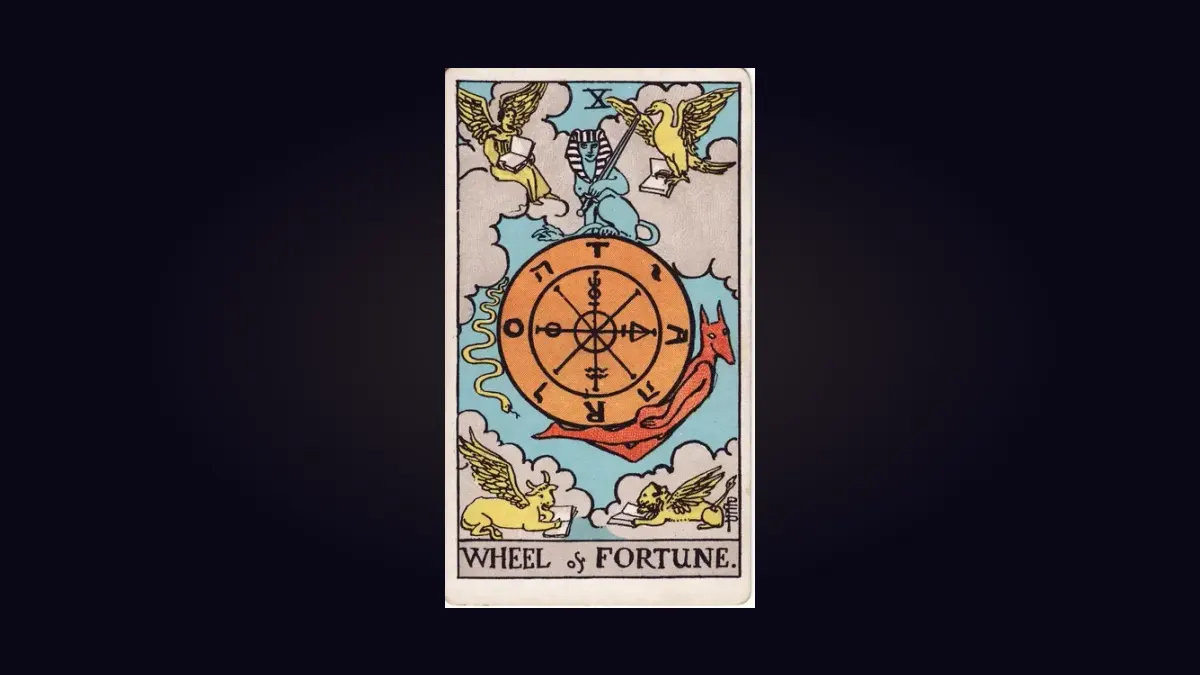
The Wheel of Fortune is the eleventh card of the Major Arcana — numbered X, following The Hermit — and the deck’s clearest signal for cyclical change. A great wheel turns in the sky, four winged figures study books at the corners, a sphinx sits atop the wheel, a snake descends one side, an Anubis figure rises the other. It is one of the most symbol-dense compositions in the Rider-Waite-Smith deck.
If you’ve drawn The Wheel in a recent reading and want the full upright and reversed reading along with position interpretations, this guide covers what the card actually means and why it isn’t simply luck. (For context on the wider deck, our Tarot for beginners guide covers the 78-card structure. To do an actual draw, the Daily Tarot tool ships the full Rider-Waite-Smith deck.)
What does The Wheel of Fortune mean in tarot?
The Wheel of Fortune (Major Arcana X) in Rider-Waite-Smith tarot reads as cyclical change — the recognition that the situation is part of a larger cycle and that your current phase will turn. The card is associated with cycles, turning points, the moment a chapter changes, and the practice of reading where you are in a larger pattern rather than imagining you control the rotation.
It is the card the tradition treats as the soul’s first encounter with patterns larger than the personal will.
The image — what’s actually on the card
Pamela Colman Smith’s 1909 illustration is the deck’s most symbol-dense single scene:
- A great wheel suspended in the sky — disconnected from the ground; the wheel turns independently of where you stand
- Hebrew letters on the wheel (YHVH and TARO/ROTA) — the divine name interlocked with the deck’s own name; cosmic structure beneath the rotation
- Alchemical symbols on the inner spokes (mercury, sulphur, water, salt) — the four classical elements; the card is the meeting place of all matter
- A sphinx with a sword sitting atop the wheel — the riddler holds the question; the answer is in the cycle, not above it
- A snake descending the left side — the falling phase; what was up is on its way down
- An Anubis figure rising the right side — the jackal-headed Egyptian deity of thresholds; what was down is rising
- Four winged figures at the corners (bull, lion, eagle, human) — the four fixed zodiac signs (Taurus, Leo, Scorpio, Aquarius); the steady frame around the moving wheel
- Books in their hands — the figures study; they don’t control the wheel, they read it
Smith was a practising Golden Dawn member when she drew the deck; the Hebrew + alchemical + zodiac density is unusual even for her — the Wheel is the deck’s most explicitly Kabbalistic composition.
The Wheel of Fortune upright
The upright Wheel carries themes the tradition treats as cyclical and impersonal:
- Cycles turning — recognition that the situation is in motion
- A new chapter beginning — what was suppressed is rising
- Recognising the pattern — seeing where on the wheel you are matters more than fighting the rotation
- Good fortune in cycles — the lucky phase as part of a larger pattern, not isolated
- The unexpected — what arrives without being engineered
A.E. Waite’s Pictorial Key to the Tarot (1910) describes the card as “Destiny, fortune, success, elevation, luck, felicity.” Smith’s illustration extends this beyond luck into structural cyclicity — the card names the cycle, not the individual outcome.
The Wheel of Fortune reversed
The reversed Wheel is the cycle resisted:
- Clinging to the current phase — refusing to let it close
- Bad-luck patch — the falling side of the wheel; not a forecast of disaster, a naming of the dip
- Resistance to change — pushing back against what’s already turning
- Misreading the cycle — thinking you’re rising when you’re falling, or the reverse
- Bad timing — acting against the cycle rather than with it
Most reversed Wheel readings are about the relationship to the change rather than the change itself. The card reads the same direction either way; reversal just shows the resistance.
The Wheel of Fortune in spread positions
In a Past / Present / Future spread (see our 3-card spread guide) the card reads differently in each slot:
- Past: a cycle that turned and shaped what came after. Often the moment a chapter you didn’t know was a chapter ended.
- Present: the wheel is turning right now. The card is asking you to read the cycle rather than fight it.
- Future: a turning point is approaching. Not necessarily good or bad — a structural shift.
In other layouts:
- Love position: a phase changing — sometimes deepening, sometimes ending, sometimes simply transforming.
- Career position: a turn in the work — project closing, role opening, industry shift. Often unexpected.
- Outcome position: the answer is “it depends where you are on the wheel.” The Wheel in outcome is rarely a single static result.
- Advice position: “ride the cycle.” The card as advice usually means working with the turn rather than against it.
Why The Wheel of Fortune isn’t simple luck
The card’s name reads as gambling-related. “Fortune” in modern English suggests random outcome, casino luck, the spin of a wheel. Beginners sometimes interpret the card as a forecast of fate — what will happen to you, no input required.
But the tradition’s deeper reading is structurally different:
- The four corner figures are studying books. They don’t bet on the wheel; they read it. The card is about reading position, not gambling on outcome.
- The sphinx with the sword sits ON the wheel. The riddle (what is the cycle about?) travels with the rotation. Knowing where you are is the work.
- The Hebrew on the wheel matters. YHVH and TARO/ROTA interlocked signals cosmic structure beneath the apparent randomness. There’s a pattern; luck is just the part you couldn’t see.
- The card follows The Hermit. Structurally, this is where the inward wisdom of solitude becomes available to read the larger cycles. The order is intentional.
Read this way, The Wheel of Fortune is one of the deck’s most practical major arcana — the card that asks you to identify which phase you’re in and ride it accordingly.
How to work with a Wheel draw
When the card shows up in a reading you actually care about:
- Read where on the wheel you are. Falling phase, rising phase, top, bottom? The card cares about position more than direction.
- Don’t fight the rotation. The wheel will turn whether or not you push back. Energy spent resisting is energy not spent reading.
- Time decisions to the cycle. Some actions only work in the rising phase; some only in the falling. The card asks for timing literacy.
- Recognise the chapter close. What’s ending? The Wheel often surfaces transitions that haven’t been named yet.
- Trust the structure underneath. The Hebrew and alchemy on the wheel signal: there is order here, even when the rotation seems random.
If you draw The Wheel and want to sit with a fuller reading — which phase, which cycle, which direction the rotation is taking the situation — the Daily Tarot tool gives you the card and the traditional interpretation in one place.
A note on framing: tarot is offered here as a reflective practice, not a predictive tool. The Wheel of Fortune is not foretelling luck. It is naming a cycle you may already be inside — and inviting you to read it accurately.
Questions about this
Is The Wheel of Fortune a good card in tarot?
Mixed, by design. The Wheel names change — sometimes welcome, sometimes not — and the recognition that you are currently in a phase of a larger cycle. Most experienced readers treat it as a wake-up card: the situation is shifting; pay attention to where on the wheel you are.
What does The Wheel of Fortune mean in a love reading?
A turning point in the relationship — sometimes a fresh chapter, sometimes the end of one. The Wheel in love rarely names predictable progress; more often it names the moment the dynamic shifts. The card is asking you to read the cycle, not to force the outcome.
What does The Wheel of Fortune mean reversed?
Reversed Wheel usually shows resistance to change — clinging to the current phase past its expiration, or refusing to see the cycle that's already turning. Sometimes it points to a bad-luck patch you're inside of. The energy is the same; reversal shows the relationship to the change is the problem.
What does The Wheel of Fortune mean in a career reading?
A turn in the work situation — a project ending, a new role opening, a structural shift in the field. The Wheel in career rarely warns; more often it names the recognition that the current chapter is closing. Often signals the need to read the wider trend rather than push the current path.
Does The Wheel of Fortune mean luck?
Not in the casino sense. The tradition treats the Wheel as cycles — what comes around naturally — rather than random luck. The card's mechanism is recognition: where you are on the wheel matters more than how you're spinning it. Riding the cycle well is the skill the card names.
For reflection — not a prediction. Full disclaimer.