
The Hermit Tarot Card Meaning (RWS) | Explain Fate
The Hermit (Major Arcana IX) in Rider-Waite-Smith tarot — upright and reversed meanings, positions, and why this card is chosen solitude as wisdom-seeking.
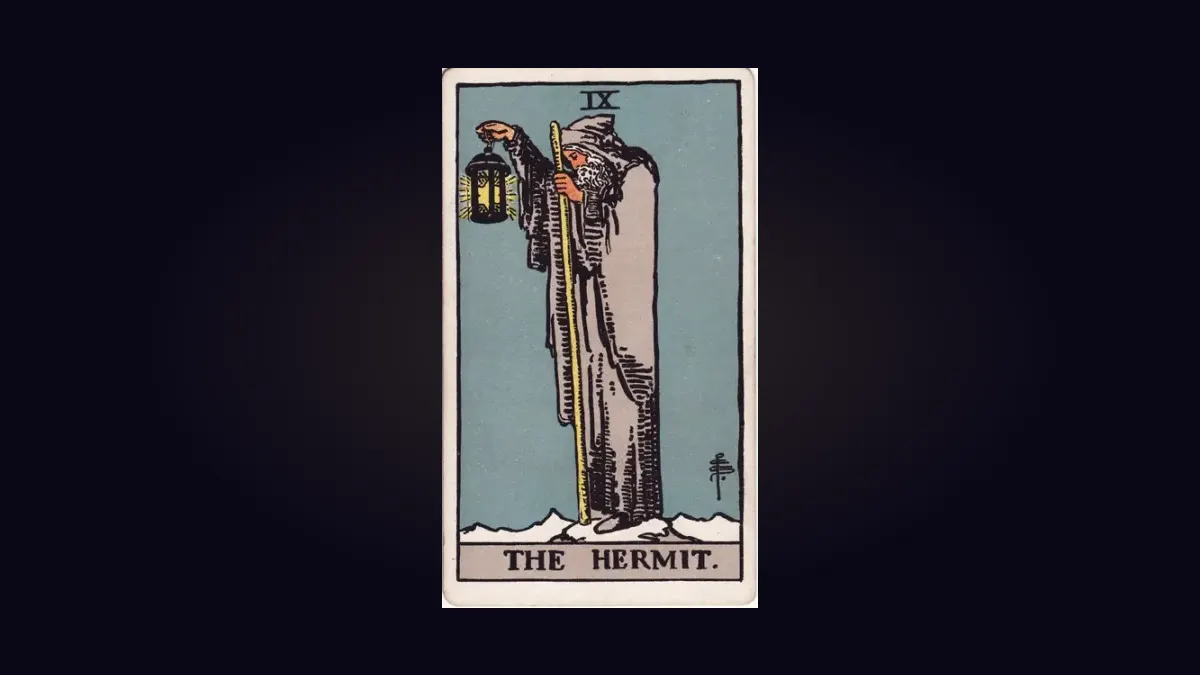
The Hermit is the tenth card of the Major Arcana — numbered IX, following Strength — and the deck’s clearest signal for chosen solitude. A cloaked figure stands alone on a snowy mountain peak holding a lantern with a six-pointed star inside, a staff in his other hand, head bowed in contemplation. It is one of the quietest compositions in the Rider-Waite-Smith deck.
If you’ve drawn The Hermit in a recent reading and want the full upright and reversed reading along with position interpretations, this guide covers what the card actually means and why it isn’t about isolation in the lonely sense. (For context on the wider deck, our Tarot for beginners guide covers the 78-card structure. To do an actual draw, the Daily Tarot tool ships the full Rider-Waite-Smith deck.)
What does The Hermit card mean in tarot?
The Hermit (Major Arcana IX) in Rider-Waite-Smith tarot reads as chosen solitude — the deliberate withdrawal from the noise of daily life to make space for wisdom. The card is associated with introspection, contemplative practice, inner light, the willingness to study what you don’t yet understand, and the patience to climb slowly toward clarity.
It is the card the tradition treats as the soul’s first deliberate inward turn — what happens when Strength’s gentle mastery becomes available for inner work.
The image — what’s actually on the card
Pamela Colman Smith’s 1909 illustration is the deck’s most austere and inward portrait:
- A cloaked figure standing alone — grey robes, no decoration, the absence of social signalling
- A snowy mountain peak under his feet — he has climbed to where the air is thin; the work has taken effort to reach
- A lantern raised in his right hand — held up rather than carried at the side; he is offering light, not just using it
- A six-pointed star inside the lantern — the Seal of Solomon, traditionally read as the union of opposites; the lantern carries integrated wisdom
- A long wooden staff in his other hand — the support of long practice; not a weapon, not a sceptre
- Bowed head, downcast eyes — the contemplative posture; not looking outward for direction
- A clear pale sky — no sun, no moon; the light in this card is the lantern’s
Smith was a practising Golden Dawn member when she drew the deck; the figure echoes Diogenes (the Greek philosopher with his lantern, seeking “an honest man”) and various contemplative monastic traditions.
The Hermit upright
The upright Hermit carries themes the tradition treats as deliberately interior:
- Introspection — the choice to look inward rather than seeking outside answers
- Solitude — chosen, structured, with a purpose; not the same as loneliness
- Inner guidance — the lantern light you carry from your own accumulated wisdom
- Spiritual study — contemplative practice, deep reading, the slow climb
- Withdrawal from noise — the deliberate stepping back to clarify
A.E. Waite’s Pictorial Key to the Tarot (1910) describes the card as “Prudence, also and especially treason, dissimulation, roguery, corruption.” Smith’s illustration ignores Waite’s darker reading and emphasises the positive contemplative meaning that modern readers (Pollack, Greer) have settled into.
The Hermit reversed
The reversed Hermit is solitude lost its purpose:
- Isolation that has hardened — the cloak became a wall
- Loneliness — withdrawal without the wisdom-seeking; the lantern unlit
- Avoidance — hiding from the question rather than studying it
- Cynicism — the climb ended at “I’ve seen enough” rather than “there’s more to learn”
- Forced solitude — exclusion, exile, the lonely kind rather than the chosen kind
Most reversed Hermit readings are about solitude that has stopped being generative. The card reads the same direction either way; reversal just shows where the inward turn has lost its purpose.
The Hermit in spread positions
In a Past / Present / Future spread (see our 3-card spread guide) the card reads differently in each slot:
- Past: a period of deliberate withdrawal that built what came after. Often a study phase, a sabbatical, or a quiet chapter that fed current clarity.
- Present: the work is asking for solitude now. The card is naming the need to step back from the noise.
- Future: an inward turn is approaching. Often a season of quiet preparation before the next visible phase.
In other layouts:
- Love position: quiet time alone, contemplation about the relationship, or a partner in their own Hermit phase.
- Career position: solo work, deep study, specialised expertise. Often signals research-mode over social-mode.
- Outcome position: the answer comes through quiet reflection. The Hermit in outcome rarely names dramatic resolution.
- Advice position: “withdraw to study.” The card as advice usually means stepping back rather than pressing forward.
Why The Hermit isn’t isolation
The card’s imagery — a solo figure on a snowy peak — reads as lonely on first glance. In a culture that prizes constant connection, the Hermit can look like withdrawal from life. Beginners sometimes interpret the card as a forecast of unwanted solitude.
But the tradition’s deeper reading is the opposite:
- The Hermit chose the mountain. The figure is not exiled; he climbed. The solitude is structural to the work, not imposed on him.
- The lantern is raised, not hidden. He is offering light to whoever follows. The card’s solitude is in service of return, not permanent withdrawal.
- The six-pointed star inside the lantern signals integration. What he’s found in solitude is intended to be brought back.
- The card sits at IX — single digit’s final position. Structurally, the Hermit completes the first half of the Major Arcana before The Wheel of Fortune begins the cycles. The inward turn is timed.
Read this way, The Hermit is one of the most practical major arcana — the card that names deliberate solitude as the precondition for wisdom that can be shared.
How to work with a Hermit draw
When the card shows up in a reading you actually care about:
- Plan the withdrawal. Drift into solitude and it can harden into isolation; choose it deliberately and it stays generative.
- Bring a lantern. The Hermit’s solitude is purposeful — what question are you carrying with you?
- Set a timeframe. This card rarely names permanent solitude; it names a chapter. Decide when you’ll come back.
- Study something. The contemplative element is structural — the card asks for active inner work, not passive isolation.
- Don’t confuse it with loneliness. Loneliness wants connection it can’t reach; the Hermit’s solitude is fed by what’s inside.
If you draw The Hermit and want to sit with a fuller reading — what to withdraw to, what question to study, what light to carry — the Daily Tarot tool gives you the card and the traditional interpretation in one place.
A note on framing: tarot is offered here as a reflective practice, not a predictive tool. The Hermit is not foretelling unwanted solitude. It is naming an inward turn you may already be ready for — and inviting you to enter it deliberately.
Questions about this
Is The Hermit a good card in tarot?
Yes, for those willing to slow down. The Hermit names a season of withdrawal and inner work. For people who need space and reflection, it's welcome. For people avoiding connection, it can read as a warning. Most experienced readers treat it as an invitation to deliberate solitude rather than a forecast of loneliness.
What does The Hermit card mean in a love reading?
Often signals a quiet phase — solo time, contemplation about the relationship, or a partner who is themselves in a Hermit phase. The Hermit in love rarely means breakup; more often it names the need for inner clarity before further action. For singles, often signals time alone as preparation, not punishment.
What does The Hermit card mean reversed?
Reversed Hermit usually shows isolation that has hardened — solitude turned into loneliness, withdrawal that has lost its purpose, or hiding from rather than studying the question. The energy is the same; reversal shows the inward turn has stopped being generative.
What does The Hermit card mean in a career reading?
Solo work, study, research, or a phase of professional reflection. The Hermit in career often points to going deep on a specialty rather than broad on connections. Sometimes it surfaces a need to step back from the noise to clarify the next move.
What's the difference between The Hermit and The High Priestess?
Both are inner-knowing cards. The High Priestess listens to what arrives from below — intuition, the subconscious. The Hermit climbs upward to seek wisdom — deliberate study, contemplative practice, lantern-light into the dark. The Priestess is receptive; The Hermit is active in his withdrawal.
For reflection — not a prediction. Full disclaimer.