
The Chariot Tarot Card Meaning (RWS) | Explain Fate
The Chariot (Major Arcana VII) in Rider-Waite-Smith tarot — upright and reversed meanings, positions, and why this card is disciplined harnessing of competing forces.
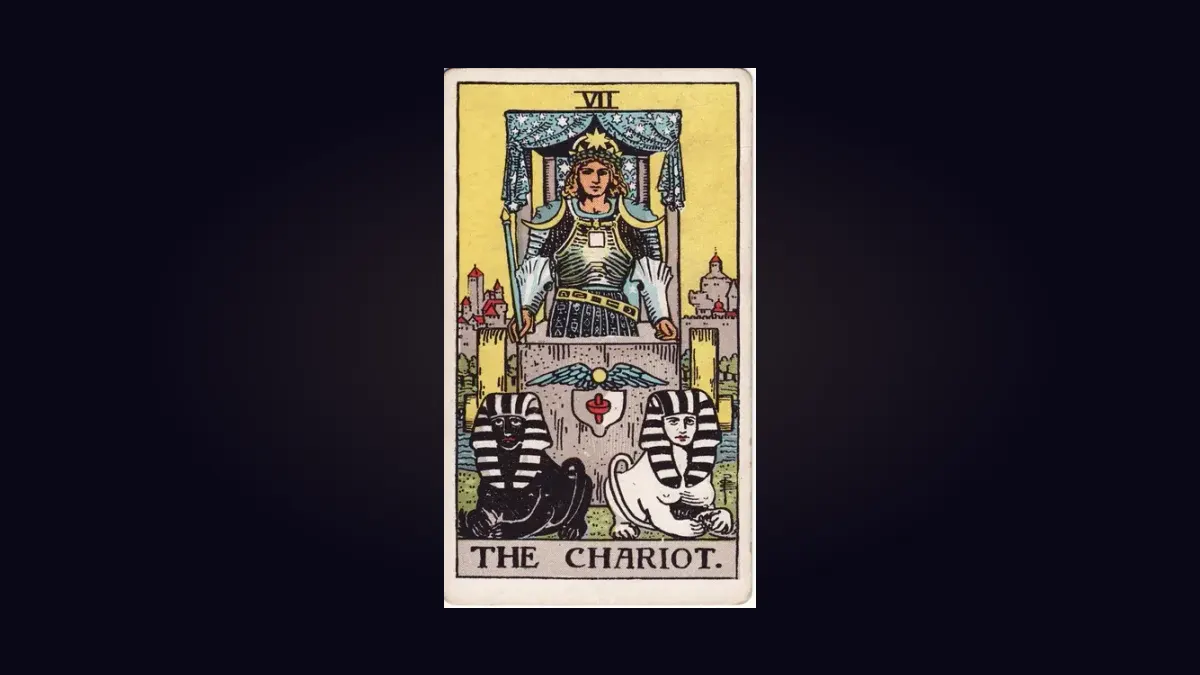
The Chariot is the eighth card of the Major Arcana — numbered VII, following The Lovers — and the deck’s clearest signal for disciplined forward motion. A figure in armour stands in a stone chariot, holding a staff, with two sphinxes (one black, one white) facing opposite directions at the front. It is one of the most kinetically charged compositions in the Rider-Waite-Smith deck.
If you’ve drawn The Chariot in a recent reading and want the full upright and reversed reading along with position interpretations, this guide covers what the card actually means and why it isn’t simply aggression. (For context on the wider deck, our Tarot for beginners guide covers the 78-card structure. To do an actual draw, the Daily Tarot tool ships the full Rider-Waite-Smith deck.)
What does The Chariot card mean in tarot?
The Chariot (Major Arcana VII) in Rider-Waite-Smith tarot reads as disciplined willpower — the capacity to harness competing forces and direct them at a single aim. The card is associated with momentum, focus, victory through sustained effort, and the recognition that meaningful progress requires holding tension rather than escaping it.
It is the card the tradition treats as the first major test of personal direction — what The Lovers’ choice becomes when it has to be lived out over time.
The image — what’s actually on the card
Pamela Colman Smith’s 1909 illustration is the deck’s most kinetically tense scene:
- A figure in armour standing in the chariot — disciplined readiness, but the chariot isn’t moving yet; the figure is mid-decision
- A stone chariot rather than a wooden one — heavy, durable, built for the long haul rather than a quick race
- Two sphinxes at the front — one black, one white — pulling in opposite directions; the figure must master both to move forward
- A canopy of stars above the figure — cosmic order at the back of personal will
- A laurel and crown on the figure’s head — victory acknowledged before it has been completed
- A walled city in the background — what he is leaving; the chariot is on a path between civilisation and the unknown
- Two moons on the figure’s shoulders — one waxing, one waning; the dual nature carried into the work
Smith was a practising Golden Dawn member when she drew the deck; the sphinxes pulling in opposite directions is the central visual idea — willpower as the management of internal contradiction.
The Chariot upright
The upright Chariot carries themes the tradition treats as disciplined and propulsive:
- Willpower — the directed kind, applied at a single aim
- Momentum — the work has accumulated enough energy to keep going
- Focused direction — choosing one path over the available alternatives
- Victory through discipline — winning by sustained effort, not by chance
- Self-mastery — holding internal contradictions without being torn by them
A.E. Waite’s Pictorial Key to the Tarot (1910) describes the card as “Succour, providence; also war, triumph, presumption, vengeance, trouble.” Smith’s illustration emphasises the triumph reading — the figure has already mastered the sphinxes; the win is in his posture.
The Chariot reversed
The reversed Chariot is direction lost:
- Loss of focus — too many aims, none of them taken seriously
- Opposing forces winning — the black and white sphinxes pulling the figure apart
- Force replacing willpower — pushing harder when the right move was to redirect
- Aimless movement — going somewhere, but not somewhere meaningful
- Loss of self-control — emotional or behavioural; the armour cracking
Most reversed Chariot readings are about diffused direction. The card reads the same direction either way; reversal just shows the discipline has slipped.
The Chariot in spread positions
In a Past / Present / Future spread (see our 3-card spread guide) the card reads differently in each slot:
- Past: a disciplined push that built what came after. Often a project or commitment you sustained through real difficulty.
- Present: the work is asking for focused direction now. The card is naming the need to choose one aim and ride it.
- Future: momentum is approaching. Not luck — earned movement, the kind that requires sustained will to receive.
In other layouts:
- Love position: the partnership needs direction or willpower to sustain it. Often signals a commitment phase.
- Career position: focused push, promotion, project momentum. The card welcomes hard work.
- Outcome position: victory through sustained effort. The Chariot in outcome is usually a yes that requires the work to land.
- Advice position: “harness the tension.” The card as advice usually means stopping the attempt to resolve contradictions and instead using them.
Why The Chariot isn’t aggression
The card’s imagery — armour, chariot, military bearing — reads as warlike on first glance. Combined with Waite’s “triumph, vengeance” language, beginners can interpret The Chariot as a card about conquest or force.
But the tradition’s deeper reading is structural, not aggressive:
- The sphinxes are the heart of the card. They face opposite directions on purpose. The Chariot’s victory is internal — holding the contradictions without letting them tear the work apart.
- The chariot isn’t moving in the image. Smith painted the figure mid-decision, before the chariot has lurched forward. The card is about the readiness to direct, not the act of charging.
- The armour is symbolic. It is not the war-armour of combat but the contained-mobility armour of someone holding a difficult role.
- The two moons on the shoulders signal duality. This card is about carrying both halves of yourself into the work, not eliminating one to win.
Read this way, The Chariot is one of the most psychologically interesting major arcana — the card of disciplined will as the management of internal contradiction.
How to work with a Chariot draw
When the card shows up in a reading you actually care about:
- Pick the aim. The Chariot’s hardest demand is choosing one direction when several are available.
- Hold the tension. The black and white sphinxes don’t go away. The card is asking you to drive with them, not over them.
- Watch for diffusion. If you’re trying to win on three fronts, the card is naming the diffusion as the problem.
- Use the armour. Some roles require structural protection — boundaries, routines, refusals. The card permits that armour.
- Don’t replace will with force. When you find yourself pushing harder, the card is asking you to redirect instead.
If you draw The Chariot and want to sit with a fuller reading — what to aim at, what tension to hold, what direction to commit to — the Daily Tarot tool gives you the card and the traditional interpretation in one place.
A note on framing: tarot is offered here as a reflective practice, not a predictive tool. The Chariot is not foretelling victory. It is naming a directional choice you may already be sitting with — and inviting you to commit to it.
Questions about this
Is The Chariot a good card in tarot?
Yes — it's one of the deck's clearest yes cards for disciplined action. The Chariot signals momentum, focus, and victory through willpower. Most experienced readers welcome it, especially at the start of a project that demands sustained effort. The card is about harnessing tension, not avoiding it.
What does The Chariot card mean in a love reading?
A relationship that demands willpower and direction — sometimes the choice to commit despite competing pulls, sometimes the work of pointing the partnership at a shared aim. The Chariot in love rarely means easy harmony; more often it names the discipline required to stay aligned.
What does The Chariot card mean reversed?
Reversed Chariot usually shows direction lost — competing forces winning, willpower turning into force, or victory undone by lack of follow-through. The energy is the same; reversal shows the discipline has slipped. Sometimes the card is asking whether you're aiming at the right target.
What does The Chariot card mean in a career reading?
Forward momentum in your work — a project, a promotion, a focused push. The Chariot in career rarely warns about competence; it warns about diffusion. The card is asking whether you're channelling effort at one clear aim or spreading it across competing priorities.
What does The Chariot mean about Cancer (the zodiac sign)?
Traditional sources link The Chariot to Cancer — the cardinal water sign. The connection is the cardinality (initiation) and the protective shell (the chariot itself). Cancer's emotional armour and The Chariot's literal armour share the same archetypal function: contained mobility.
For reflection — not a prediction. Full disclaimer.