
The Lovers Tarot Card Meaning (RWS) | Explain Fate
The Lovers (Major Arcana VI) in Rider-Waite-Smith tarot — upright and reversed meanings, position interpretations, and why the card is about choice as much as romance.
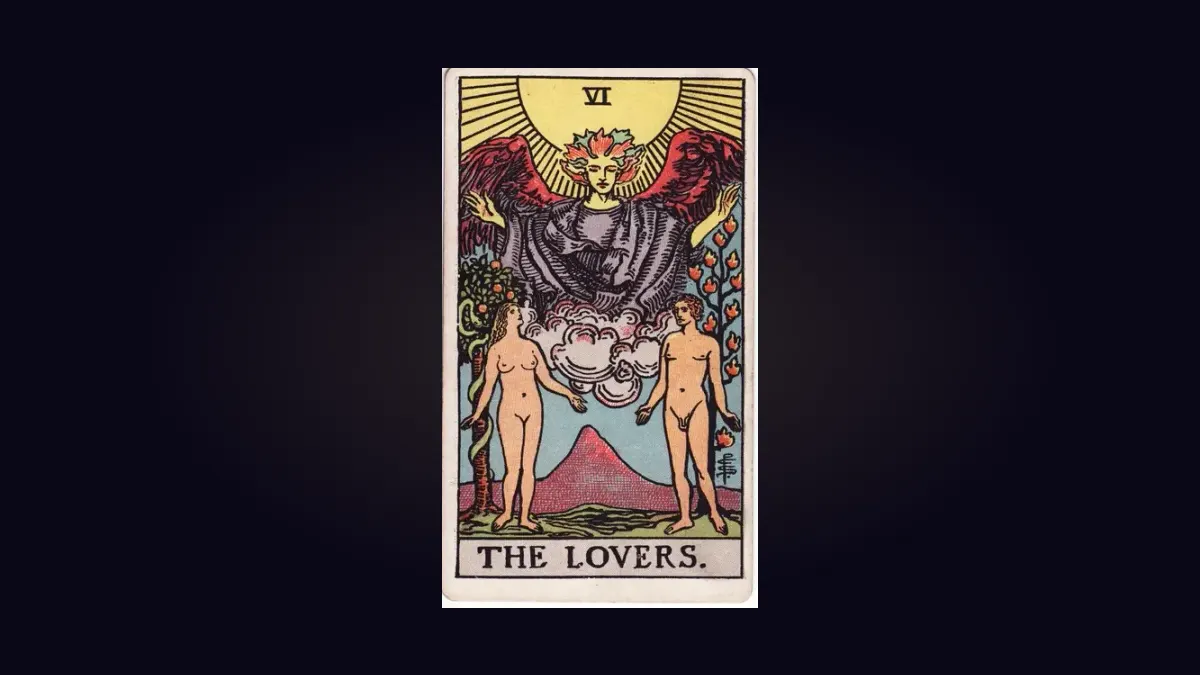
The Lovers is the sixth card of the Major Arcana — and the most consistently misread card in the romantic direction in the Rider-Waite-Smith deck. A naked man and woman beneath an angel, in an open garden, with the tree of knowledge behind them. It is also one of the most subtle cards in the deck, because it is rarely about romance in the way beginners expect.
If you’ve drawn The Lovers in a recent reading and want to know what the card actually means beyond “you’ll find love”, this guide walks the upright and reversed reading, the position-specific interpretations, and why the card is fundamentally about choice and alignment. (For context on the wider deck, our Tarot for beginners guide covers the 78-card structure. To do an actual draw, the Daily Tarot tool ships the full Rider-Waite-Smith deck.)
What does The Lovers card mean in tarot?
The Lovers (Major Arcana VI) in Rider-Waite-Smith tarot reads as alignment and choice — the recognition of a partnership, decision, or path where what you value and what you choose are in harmony. The card is associated with partnership, the alignment of values, the choice that defines a life, and the honesty required to choose accordingly.
It is romantic in some readings and entirely non-romantic in others. The deeper reading is always about alignment.
The image — what’s actually on the card
Pamela Colman Smith’s 1909 illustration is unusually rich in religious and mythic symbolism:
- A naked man and woman standing in a garden — the unclothed figures read as honesty and openness, not just romance; they have nothing to hide from each other
- An angel (often identified as Raphael) above them with arms outstretched, blessing the union — the divine presence implied in a true alignment
- The sun behind the angel — clarity and warmth on the whole scene
- A mountain rising between the two figures — the third element they orient around together, the shared aspiration
- A tree behind the woman with twelve flames — the tree of knowledge, often linked to the twelve zodiac signs
- A tree behind the man with twelve fruits — the tree of life, fruitful and grown
- A serpent coiled around the woman’s tree — the awareness of choice; knowing what you choose against, not just for
Smith was a practising Golden Dawn member when she drew the deck; the dual-tree composition deliberately echoes Eden, with consent and awareness restored.
The Lovers upright
The upright Lovers carries themes the tradition treats as orienting:
- Partnership — a relationship, collaboration, or alliance grounded in mutual recognition
- Alignment of values — the clearest reading of the card: what you want and what they want are pointed in the same direction
- Choice — the card sits at a decision point; not “which option” but “which version of yourself”
- Love as commitment — not the spark (that’s the Two of Cups) but the choice to keep showing up
- Honesty — the figures are naked because pretence doesn’t work here; the card asks for the unguarded version
A.E. Waite’s Pictorial Key to the Tarot (1910) describes the card as “Attraction, love, beauty, trials overcome” — but Smith’s composition makes clear the card is about the choice that follows attraction, not the attraction itself.
The Lovers reversed
The reversed Lovers is the same energy with the alignment missing:
- Values out of alignment — the partnership exists but the directions don’t match
- An unmade choice — sitting at a fork rather than walking down it
- Disharmony — a relationship running on momentum or history rather than active choice
- Romantic confusion — wanting more than one thing; not knowing which want is the real one
- Avoiding the honest conversation — the alignment question is being deferred
Most reversed Lovers readings are about an alignment question being avoided. The card reads the same direction either way; reversal just shows where the honesty is missing.
The Lovers in spread positions
In a Past / Present / Future spread (see our 3-card spread guide) the card reads differently in each slot:
- Past: a choice or relationship that defined what came after. Often the moment you chose your current path.
- Present: an alignment question is live right now. The card is asking what you value and whether you’re choosing accordingly.
- Future: a meaningful choice is approaching — a partnership, a path, a values commitment. Not necessarily romantic.
In other layouts:
- Love position: partnership grounded in alignment; or, in a difficult reading, the question of whether the current alignment still holds.
- Career position: a work choice where values matter — a collaborator to commit to, a role to accept or decline.
- Outcome position: the answer is to choose, and to choose in alignment with what you actually value rather than what’s convenient.
- Advice position: “be honest about what you want.” The card as advice usually means stopping the deferral.
Why The Lovers isn’t always about romance
The card scares and confuses people for the opposite reason Death does. The imagery is so romantic — naked figures, angel, garden — that beginners read it as a love forecast and miss the deeper layer. When the card appears for a non-romantic question, they assume it has been misread.
But the tradition’s deeper reading is consistent across teachers:
- The card sits at VI in the Fool’s Journey. It comes after the Hierophant (the inherited values) and before the Chariot (disciplined direction). Its placement is structural: this is where the Fool first chooses for himself.
- The angel and the trees frame a choice, not a wedding. The composition is about commitment and consent, which apply to any meaningful alignment.
- Smith painted the figures looking at the angel, not each other. They are aligning to something larger together — the structure of the card is triangular, not paired.
- The keywords across teachers are “values” and “choice” as often as “love” — Rachel Pollack, Mary K. Greer, and Biddy Tarot all emphasise the alignment reading.
Read this way, The Lovers is one of the more practical major arcana — the one that asks whether what you’re choosing reflects who you actually are.
How to work with a Lovers draw
When the card shows up in a reading you actually care about:
- Ask which alignment. Sometimes the answer is romantic. Often it isn’t — a job, a friendship, a creative direction, a way of being in the world.
- Notice what you’re choosing against. The serpent on the tree is in the picture deliberately; the card is asking what you’re saying no to as much as what you’re saying yes to.
- Be honest with yourself first. The naked figures aren’t just open with each other; they’re open with themselves. The card is hard to read clearly while pretending.
- Don’t defer the choice. The Lovers’ shadow is the unmade decision. The energy of the card wants movement.
- Look at the values, not just the feelings. Feelings change; values are more stable. The card is asking about the deeper layer.
If you draw The Lovers and want to sit with a fuller reading — what alignment, what choice, what you actually value — the Daily Tarot tool gives you the card and the traditional interpretation in one place, and you can carry the focus question with you through the day.
A note on framing: tarot is offered here as a reflective practice, not a predictive tool. The Lovers is not foretelling a partner. It is naming an alignment question you might already be sitting with — and inviting you to answer it honestly.
Questions about this
What does the lovers card mean in tarot?
The Lovers card (Major Arcana VI) means alignment, choice, and values — a moment when an inner decision about who and what you align with reaches the surface. It is not primarily a romance card in the traditional reading; the partnership it names can be with a person, a path, or a vocation. Most modern readers treat the card as a values-recognition signal.
Does The Lovers card mean I'll find love?
Not predictively. The Lovers in modern tarot reads as alignment, choice, and values rather than as a romantic forecast. In a love-focused reading it often points to a partnership where values match — but it appears just as often for non-romantic choices about who and what you align with. Tarot is offered here as reflective, not predictive.
What does The Lovers card mean in a love reading?
A relationship where values are aligned, or a clarifying moment in an existing one — the card asks whether the partnership reflects what each person actually wants. The Lovers rarely names the meeting itself; more often it names the recognition. It can also indicate a choice point where the relationship's future depends on honesty.
What does The Lovers card mean reversed?
Reversed Lovers usually shows values out of alignment, an unmade choice, or a partnership running on momentum rather than clarity. The energy is the same; reversal just shows where the alignment is missing. The card is asking what hasn't been said honestly — to a partner, or to yourself.
What does The Lovers card mean in a career reading?
A meaningful work decision where what you choose has to match what you value — accepting or declining a role, choosing between collaborators, committing to a direction. The Lovers in career is not about romance at work; it's about whether the path you're choosing reflects who you actually are.
What's the difference between The Lovers and the Two of Cups?
The Two of Cups is the daily love card — two people meeting, mutual attraction, the moment of connection. The Lovers is the archetypal choice card — values, alignment, the decision that shapes a life. The Two is the spark; The Lovers is the orientation underneath. They often appear together in love readings for that reason.
For reflection — not a prediction. Full disclaimer.