
Strength Tarot Card Meaning (RWS) | Explain Fate
Strength (Major Arcana VIII) in Rider-Waite-Smith tarot — upright and reversed meanings, positions, and why this card is quiet courage that doesn't dominate.
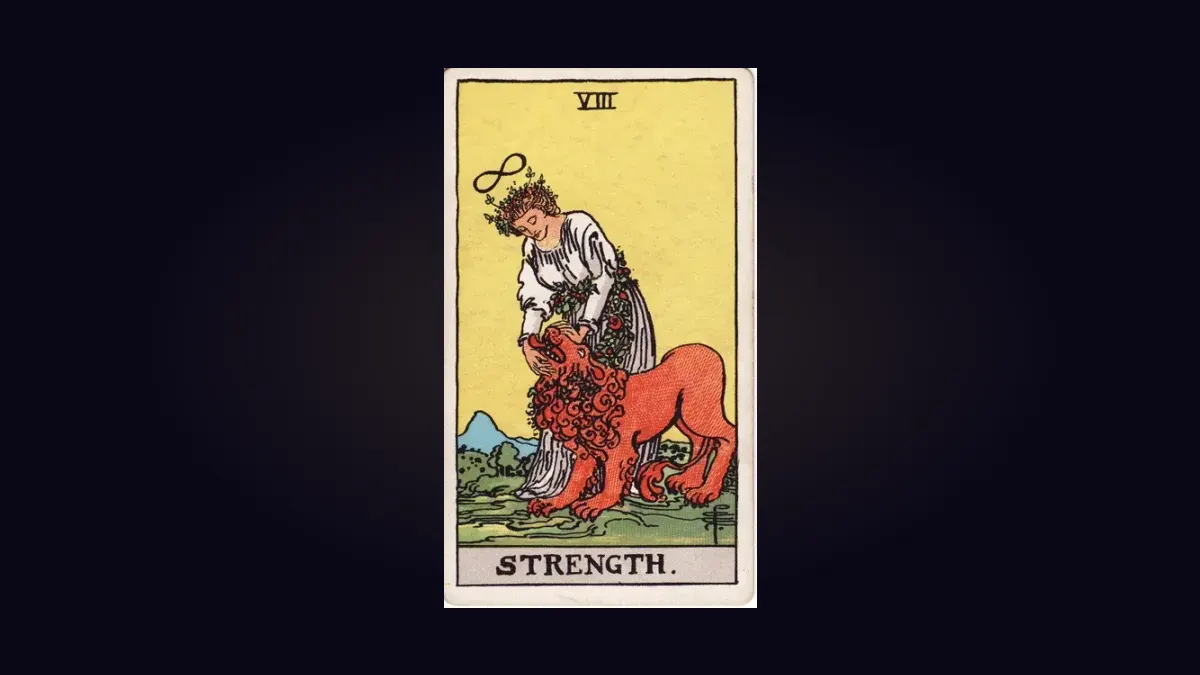
Strength is the ninth card of the Major Arcana — numbered VIII in the Rider-Waite-Smith deck — and the deck’s clearest signal for quiet inner courage. A woman in a white robe gently holds the jaw of a lion, an infinity symbol above her head, a wreath of flowers crowning her, mountains in the distance. It is one of the gentlest compositions in the deck despite its subject matter.
If you’ve drawn Strength in a recent reading and want the full upright and reversed reading along with position interpretations, this guide covers what the card actually means and why it isn’t about muscle. (For context on the wider deck, our Tarot for beginners guide covers the 78-card structure. To do an actual draw, the Daily Tarot tool ships the full Rider-Waite-Smith deck.)
What does Strength mean in tarot?
Strength (Major Arcana VIII) in Rider-Waite-Smith tarot reads as inner courage — the gentle kind that doesn’t need to dominate. The card is associated with patience, self-mastery, the calm handling of difficult forces (internal or external), and the recognition that real strength is rarely loud.
It is the card the tradition treats as the soft counterpart to The Chariot’s disciplined will — where The Chariot harnesses tension with armour, Strength does it with presence.
The image — what’s actually on the card
Pamela Colman Smith’s 1909 illustration is the deck’s most counterintuitive portrait of power:
- A woman in a white robe — softness, not armour; the absence of military signalling is deliberate
- A lion with its jaw gently opened by her hand — she is not forcing the lion’s mouth shut; she is calming it
- Her hands rest lightly on the lion’s head — no grip, no domination; the lion appears willing
- An infinity symbol above her head — the same lemniscate The Magician carries; the source of strength is the same eternal flow
- A wreath of flowers across her chest and crown — softness as the marker of her authority
- A blue mountain in the background — like The Emperor’s range, but distant and softer
- A clear bright sky — none of The Tower’s lightning or The Moon’s ambiguity; this card’s strength is in daylight
Smith was a practising Golden Dawn member when she drew the deck; the contrast between the lion (raw force) and the figure (gentle handling) is the entire visual argument of the card.
Strength upright
The upright Strength carries themes the tradition treats as quietly authoritative:
- Inner courage — the kind that doesn’t need to perform itself
- Patience — the willingness to handle difficult things slowly and well
- Compassion — strength expressed as care rather than dominance
- Self-mastery — calming your own lion (anger, fear, appetite) without suppressing it
- Influence through presence — the way calm changes a room
A.E. Waite’s Pictorial Key to the Tarot (1910) describes the card as “Power, energy, action, courage, magnanimity; also complete success and honours.” Smith’s illustration extends this into something specifically interior: the strength is in the figure’s posture, not in the lion’s submission.
Strength reversed
The reversed Strength is inner force out of balance:
- Self-doubt — the lion winning the internal argument
- Force replacing gentleness — gripping instead of calming
- Suppression — controlling rather than handling
- Anger turned inward — strength used against the self
- Exhaustion from carrying too much — the lion is heavy when there’s no rest
Most reversed Strength readings are about the gentleness slipping. The card reads the same direction either way; reversal just shows where the soft approach has been abandoned.
Strength in spread positions
In a Past / Present / Future spread (see our 3-card spread guide) the card reads differently in each slot:
- Past: a difficult thing you handled with quiet courage. Often a period of patience that built capacity you’re now drawing on.
- Present: a difficult situation is asking for gentleness rather than force. The card is naming the soft approach as the right one.
- Future: an inner mastery is approaching. Often a lesson in patience that the current phase is preparing you for.
In other layouts:
- Love position: patience and gentle handling. Strength in love rarely names dramatic intervention; it names the choice to be kind through difficulty.
- Career position: quiet competence, long-arc trust-building, handling difficult colleagues with composure.
- Outcome position: the answer comes through sustained gentleness. Strength in outcome rarely means dramatic victory.
- Advice position: “be patient.” The card as advice usually means slowing the response rather than escalating it.
Why Strength isn’t muscle
The card’s name reads as physical power, and modern usage of “strength” reinforces that. Beginners often imagine the card is about pushing harder, lifting more, winning by force. The lion in the image deepens the misread.
But the tradition’s deeper reading is structurally opposed to that:
- The figure is unarmed. Smith painted her with no weapon, no armour, no defensive posture. The strength is in her composure.
- The lion is being calmed, not subdued. Look at the hands — they rest, they don’t grip. The lion’s mouth is open under her touch, not forced shut.
- The infinity symbol matches The Magician’s. The same eternal source flows through both cards, but expressed differently: The Magician acts; Strength endures.
- The card sits at VIII, after The Chariot. Structurally, this is where the disciplined willpower of The Chariot’s armour gives way to the inner mastery of Strength’s gentleness. The order is intentional.
Read this way, Strength is one of the deck’s most counterintuitive cards — the one that names quiet courage as the real form of power.
How to work with a Strength draw
When the card shows up in a reading you actually care about:
- Be patient with the lion. Whatever’s roaring in you (or near you) wants to be calmed, not silenced.
- Don’t escalate. The card’s hardest instruction is not meeting force with more force.
- Use presence, not pressure. Strength’s mechanism is the steady availability of calm, not the application of force.
- Honour the slow arc. This card rarely produces dramatic moments. The result lands over time.
- Take care of the strong one. When you are the one holding things, the card sometimes names your need for rest.
If you draw Strength and want to sit with a fuller reading — what to handle gently, what lion to calm, where to find the patience — the Daily Tarot tool gives you the card and the traditional interpretation in one place.
A note on framing: tarot is offered here as a reflective practice, not a predictive tool. Strength is not foretelling a victory. It is naming an inner courage you may already be carrying — and inviting you to trust the soft approach.
Questions about this
Is Strength a good card in tarot?
Yes — it's one of the deck's quietest yes cards. Strength signals inner courage, patience, and the kind of quiet authority that doesn't need to dominate. Most experienced readers welcome it. The card is rarely about visible victory; more often it names a difficult internal mastery.
What does Strength mean in a love reading?
A relationship that's been tested and held — patience through difficulty, the gentle handling of someone else's harder moments, or your own emotional self-mastery within the partnership. Strength in love rarely names the easy phase; more often it names the choice to stay kind through the hard one.
What does Strength mean reversed?
Reversed Strength usually shows inner force out of balance — either self-doubt that has eroded confidence, or aggression replacing the gentle approach. The energy is the same; reversal shows the strength turned against itself or against others. Most reversed readings are about the gentleness slipping.
What does Strength mean in a career reading?
Quiet competence and the patience to handle difficult work or difficult people. Strength in career rarely points to dramatic promotion; more often it names the sustained reliability that gets noticed slowly. The card welcomes the long arc of being trusted.
Why is Strength numbered VIII in some decks and XI in others?
The original Marseille and most pre-RWS decks numbered Justice as VIII and Strength as XI. A.E. Waite swapped them in the 1909 RWS deck to align with the Golden Dawn's astrological correspondences (Strength to Leo, which sits earlier in the zodiac than Justice to Libra). Most modern decks follow the RWS numbering.
For reflection — not a prediction. Full disclaimer.