
Death Tarot Card Meaning (RWS) | Explain Fate
Death tarot card meaning (Major Arcana XIII) in Rider-Waite-Smith — upright + reversed reads, position interpretations, and why the card is rarely about literal death.
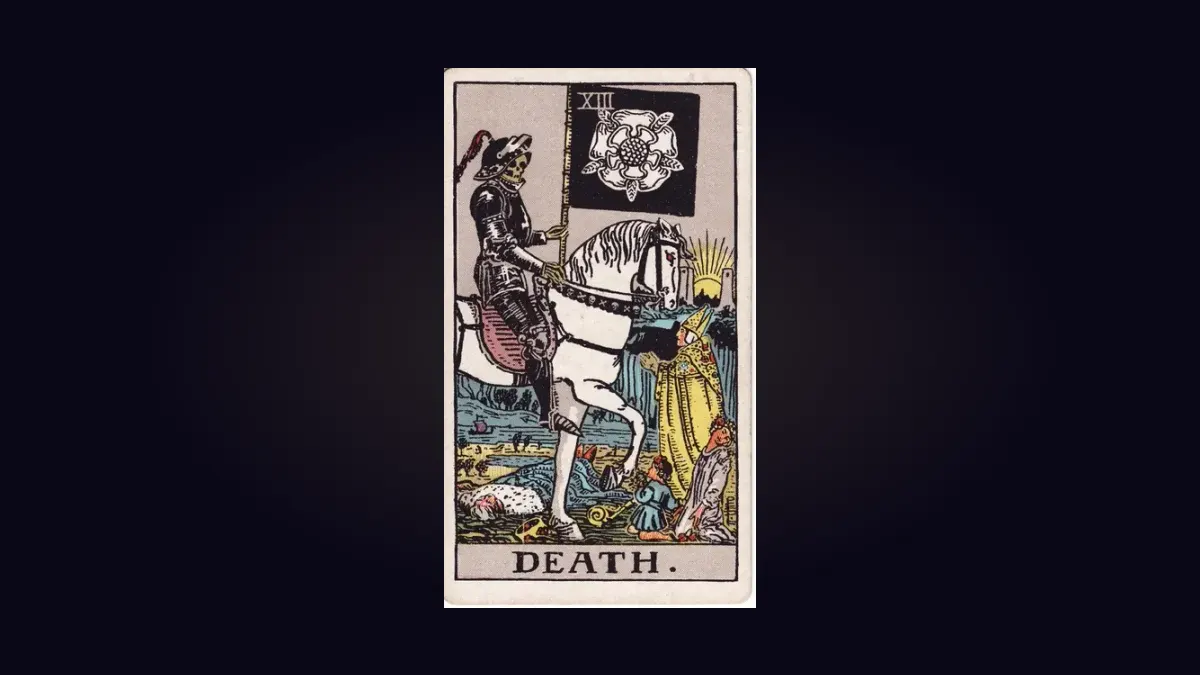
The Death card is the thirteenth card of the Major Arcana — and almost certainly the most misunderstood card in the Rider-Waite-Smith deck. A skeleton in black armour, a white rose on his banner, figures kneeling before him. It is also one of the most consistently welcoming cards in modern tarot, despite first appearances.
If you’ve drawn Death in a recent reading and want to know what it actually means before you read too much into the imagery, this guide covers the upright and reversed reading, the position-specific interpretations, and why the card is rarely about literal death. (For context on the wider deck, our Tarot for beginners guide covers the 78-card structure. To do an actual draw, the Daily Tarot tool ships the full Rider-Waite-Smith deck.)
What does the Death card mean in tarot?
The Death card (Major Arcana XIII) in Rider-Waite-Smith tarot reads as transformation — the ending of a phase that makes space for what comes next. The card is associated with completion, release, the integrity of letting something close, and the recognition of an ending that may already have happened internally even if the external form is still standing.
It is rarely literal. The tradition is consistent on this across teachers — Death names a chapter close, not a mortality.
The image — what’s actually on the card
Pamela Colman Smith’s 1909 illustration packs the card’s apparent menace with deliberate counter-symbols:
- A skeleton in black armour riding a white horse — the figure of Death itself, but armoured and mounted, not sneaking
- A white rose on a black banner — purity and renewal carried into the ending; the rose is one of the deck’s clearest hope symbols
- A fallen king in the foreground, crown still beside him — even worldly power doesn’t escape transition
- A bishop, a woman, and a child kneeling — three responses to Death: pleading, averted, accepting. The child looks most directly at the figure
- A rising sun between two towers in the background — the Star or Sun’s rebirth implied even within the Death card itself
- A river flowing through the scene — the constant of change, moving regardless
Smith was a practising Golden Dawn member when she drew the deck; the soft symbols are placed inside the menacing ones on purpose.
Death upright
The upright Death card carries themes the tradition treats as cleanly transformative:
- An ending that has integrity — the kind of close that feels complete rather than cut short
- Transformation — what was solid becoming something else; not loss but change of state
- Release — letting something fall away that you’ve already finished with internally
- Transition — a threshold moment; the card sits at the literal halfway point of the Major Arcana
- Rebirth in the same body — the figures in the foreground aren’t dying; they are watching the old form pass
A.E. Waite’s Pictorial Key to the Tarot (1910) describes the card as “End, mortality, destruction, corruption” — but Smith’s illustration carries far more nuance than Waite’s text. Most modern readers (Rachel Pollack, Mary K. Greer) read Death as the kindest of the difficult majors.
Death reversed
The reversed Death card is the same energy held back:
- Holding on past the point of usefulness — the chapter is over but you haven’t acknowledged it
- Fear of change — the threshold is in front of you and you’re standing still
- Stagnation — energy that should be moving is pooling
- A transition being refused — sometimes consciously, sometimes not
- Delayed grief — the ending happened; the grieving hasn’t
Most reversed Death readings are about resistance rather than escape. The card reads the same direction either way; reversal just shows where the resistance lives.
Death in spread positions
In a Past / Present / Future spread (see our 3-card spread guide) the card reads differently in each slot:
- Past: an ending you’ve already lived through. What closed allowed what is now. Often a reading of quiet gratitude — the chapter ending was the right thing.
- Present: something is finishing right now. The work is to let it complete cleanly rather than dragging it out.
- Future: a transition is approaching. Not a warning — a preparation. The question is how you want to meet it.
In other layouts:
- Love position: the end of a phase of the relationship, sometimes the relationship itself if it has been over emotionally for a long time.
- Career position: leaving a role or identity. Frequently the job you have already stopped fitting into.
- Outcome position: a chapter close as the answer. The thing you’re asking about ends; what comes after isn’t shown in this draw.
- Advice position: “let it close.” The card as advice usually means stopping the rescue of something already finished.
Why Death isn’t death (and why people think it is)
The card scares people for obvious reasons. Skeleton, scythe (in some decks), black armour, the word Death written on the bottom. Combined with horror-movie iconography and the deep human fear of mortality, the card does its own pre-reading work on a beginner.
But the tradition’s deeper reading is consistent across teachers:
- The card sits at XIII — the midpoint of the Major Arcana, not the end. The deck has 21 numbered cards plus The Fool; Death is exactly halfway. Endings in the middle of a sequence are transitions, not finales.
- The figures in the foreground are not dying. Three of them are conscious witnesses; the child looks directly at the skeleton without flinching.
- The white rose carries renewal forward. Smith placed it on the banner deliberately — the symbol of purity and new beginnings, held by Death itself.
- The rising sun is in the same frame. Smith painted the dawn between the two towers in the background; the Star (XVII) and the Sun (XIX) are both implied to follow.
Read this way, the Death card is one of the gentler major arcana — the one that asks you to recognise an ending you may already be feeling, and to release rather than resist it.
How to work with a Death draw
When the card shows up in a reading you actually care about:
- Ask which ending. Sometimes the answer is obvious. Sometimes the card is naming a chapter close you haven’t fully acknowledged.
- Don’t make it bigger than it is. Death almost never means mortality. Read it as transition first; the literal reading is rarely the right one.
- Notice what you’ve already finished. The card often names something that is already over internally — the external form hasn’t caught up yet.
- Let the ending complete. Death’s gift is the clean close; resist the urge to drag out what wants to finish.
- Look for what comes after. Temperance (XIV) follows Death in the sequence — integration, blending, the patient new mixture. The deck’s order is not accidental.
If you draw Death and want to sit with a fuller reading — what’s ending, what’s already gone, what’s beginning — the Daily Tarot tool gives you the card and the traditional interpretation in one place, and you can carry the focus question with you through the day.
A note on framing: tarot is offered here as a reflective practice, not a predictive tool. The Death card is not foretelling loss. It is naming a transition you might already sense — and inviting you to meet it rather than fear it.
Questions about this
What does the death card mean in tarot?
The Death card (Major Arcana XIII) means transformation rather than literal death — a clear chapter close, the end of a phase, or the release of something that has run its course. Modern tarot tradition (Waite, Pollack, Greer, Bunning) reads the card as one of the gentlest endings in the deck. Most experienced readers welcome a Death draw without fear; new readers tend to misread the imagery.
Does the Death card mean someone is going to die?
Almost never. Modern tarot tradition (Waite, Pollack, Greer, Bunning) reads Death as transformation rather than literal mortality — an ending that makes space for what comes next. New readers tend to fear the card; experienced readers tend to welcome it as one of the kindest signals in the deck.
What does the Death card mean in a love reading?
Usually the end of a phase rather than the end of a relationship — a version of the partnership that has run its course making room for a more honest one. Sometimes it does name a real ending, particularly when something has been over emotionally for a long time. Either way the card is about releasing what is already done.
What does the Death card mean reversed?
Reversed Death usually points to a transition being refused — holding on past the point of usefulness, fear of letting something close, or stagnation in a chapter that wants to end. The energy of the card is the same; reversal just shows the resistance. The ending hasn't gone away; it's been postponed.
What does the Death card mean in a career reading?
A clear chapter close — leaving a role, closing a business, the end of an identity built around a job. Death in career rarely means failure; more often it names the moment you stop pretending the current path still fits. Whatever follows is usually freer, even when it's uncertain.
What's the difference between Death and The Tower?
Both are endings, but Death is a soft, recognised completion — the closing chapter you can feel coming. The Tower is sudden collapse of something built on false ground. Death tends to be welcomed once you see it; The Tower tends to shock. They're partners in the deck's vocabulary for endings, not duplicates.
For reflection — not a prediction. Full disclaimer.