
The Sun Tarot Card Meaning (RWS) | Explain Fate
The Sun tarot card meaning (Major Arcana XIX) in Rider-Waite-Smith — upright + reversed reads, position interpretations, and why the card is the deck's clearest yes.
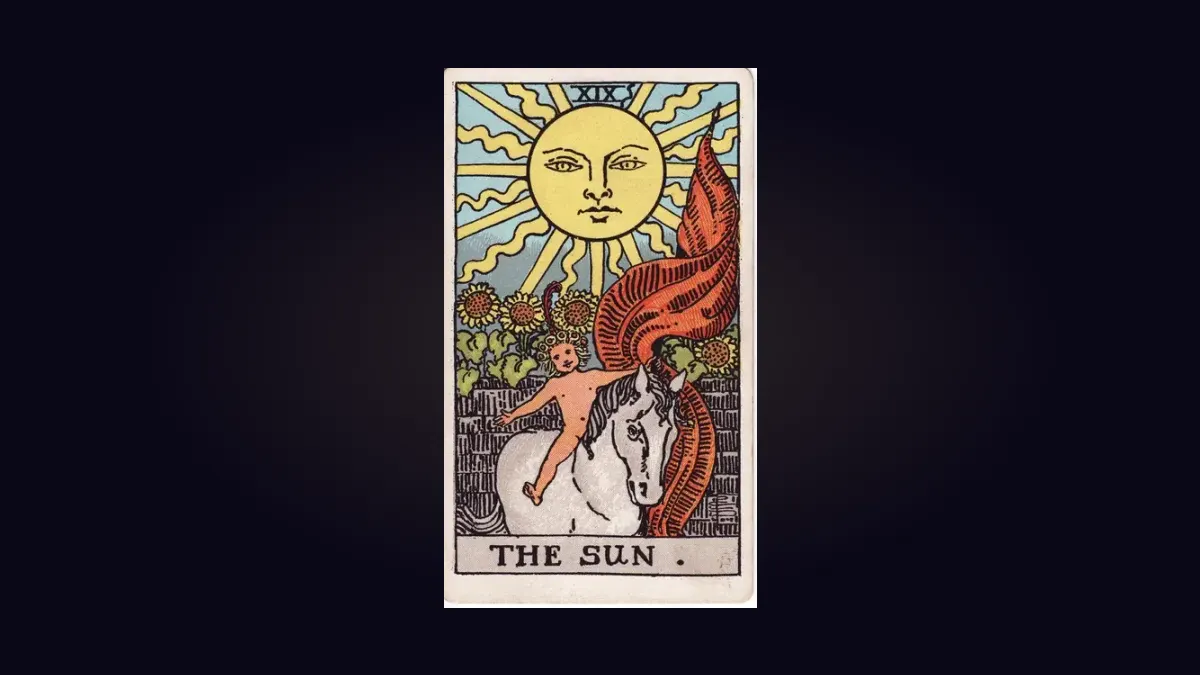
The Sun is the nineteenth card of the Major Arcana — and the deck’s most uncomplicated yes. A child rides a white horse in a field of sunflowers, a red banner held high, the sun overhead in a clear blue sky. It is one of the few cards in the Rider-Waite-Smith deck that means almost exactly what the imagery suggests.
If you’ve drawn The Sun in a recent reading and want the full upright and reversed reading along with position interpretations, this guide covers what the card actually means and why it consistently shows up at moments of genuine wholeness. (For context on the wider deck, our Tarot for beginners guide covers the 78-card structure. To do an actual draw, the Daily Tarot tool ships the full Rider-Waite-Smith deck.)
What does The Sun card mean in tarot?
The Sun (Major Arcana XIX) in Rider-Waite-Smith tarot reads as joy, vitality, and the wholeness that follows a long inward season. The card is associated with success, clarity, warmth, and the quiet confidence of being clearly seen. It is one of the few major arcana the tradition treats as straightforwardly positive — the deck’s clearest signal that things are going well, or about to.
It is the card most readers welcome without hesitation.
The image — what’s actually on the card
Pamela Colman Smith’s 1909 illustration is the deck’s most cheerful composition:
- A naked child riding a white horse — the open, unguarded self after a long journey of integration; the figure is wholly visible because there is nothing to hide
- A white horse without saddle or bridle — natural movement, vitality unforced
- A red banner held by the child, sometimes read as the joy carried into the world
- A field of sunflowers behind a stone wall — the four sunflowers often linked to the four suits of the Minor Arcana, the whole deck in bloom
- A large radiant sun overhead with a human face — the Sun as a witness, not just a light source
- A clear blue sky — no clouds, no ambiguity; the visibility is the point
- A stone wall behind the child — the structures built over the prior chapters; the child has come through and is in front of them now
Smith was a practising Golden Dawn member when she drew the deck; the composition deliberately shows the soul fully emerged into daylight after the night-passage of The Moon (XVIII).
The Sun upright
The upright Sun carries themes the tradition treats as cleanly positive:
- Joy — the unguarded, uncomplicated kind that arrives after harder work
- Vitality — physical and emotional energy that doesn’t have to be summoned
- Success — visible, recognised, deserved
- Clarity — the cloud has lifted; what was hidden is in plain view
- Wholeness — the parts of the self that have been working separately are now working together
A.E. Waite’s Pictorial Key to the Tarot (1910) describes the card as “Material happiness, contentment, glory” — Smith’s illustration extends this into something more inward: not just happiness, but the integration that allows happiness to land.
The Sun reversed
The reversed Sun is the same energy with a cloud across it:
- A dimming of joy — something genuinely going well that you’re having trouble feeling
- Difficulty receiving good news — the warmth is there; the openness to receive it isn’t quite
- Self-doubt — questioning a clear win
- Delays — clarity that’s been postponed rather than denied
- Overshadowed wins — success that’s been quiet rather than recognised
Most reversed Sun readings are about reception rather than absence. The card reads the same direction either way; reversal just shows the cloud, not the sun.
The Sun in spread positions
In a Past / Present / Future spread (see our 3-card spread guide) the card reads differently in each slot:
- Past: a bright period that shaped what came after. Often a chapter of genuine flourishing that the current reading is benefiting from.
- Present: clarity and warmth are available right now. The work is to receive them rather than reach past them.
- Future: a bright phase is approaching. Not luck — earned. The reading is usually a permission to keep going.
In other layouts:
- Love position: the relationship is healthy, or a healthy relationship is opening. The Sun rarely warns in love.
- Career position: recognition, success, a phase of clear momentum. Often a yes on a question you’re nervously asking.
- Outcome position: the answer is bright. One of the most welcome cards in this slot.
- Advice position: “be visible.” The card as advice usually means stepping into the open rather than staying small.
Why The Sun isn’t “everything is fine”
The card looks like the simplest in the deck — naked child, sunflowers, smiling sun. New readers can dismiss it as “the easy card” and miss the depth underneath.
But the tradition’s deeper reading is consistent across teachers:
- The Sun is the third card in the night-passage sequence. The Star (XVII) is hope returning, The Moon (XVIII) is the territory of dreams and unfamiliar paths, The Sun (XIX) is full emergence into daylight. Reading it without that journey context loses the weight of what the card resolves.
- The child is naked, not because nothing has happened, but because everything has. The figure has come through enough to no longer need protection.
- The sunflowers are blooming on the other side of a wall. The structure is real; the Sun is the moment of being in front of it rather than behind it.
- Smith placed the sun’s face deliberately. The card is witnessed; the joy isn’t private. Recognition is part of the card’s meaning.
Read this way, The Sun is the major arcana’s clearest moment of arrival — joy that has weight because it was earned.
How to work with a Sun draw
When the card shows up in a reading you actually care about:
- Receive it. The Sun’s most-missed instruction is to actually let the good thing in. Many people deflect joy almost reflexively.
- Be visible. The card asks for the openness it depicts. Hiding the win is the inverse of what the card invites.
- Don’t search for the catch. The Sun is one of the rare cards where the bright reading is the deepest reading. Looking for the shadow is usually you, not the card.
- Notice what you’ve already integrated. The card often shows up at moments of quiet arrival — work you did long enough ago that you’ve forgotten you did it.
- Share the warmth. The Sun’s energy is generative; it tends to multiply when extended outward rather than hoarded.
If you draw The Sun and want to sit with a fuller reading — what’s arriving, what you’ve integrated, where the warmth is asking to land — the Daily Tarot tool gives you the card and the traditional interpretation in one place, and you can carry the focus question with you through the day.
A note on framing: tarot is offered here as a reflective practice, not a predictive tool. The Sun is not foretelling a perfect day. It is naming a wholeness you might already be carrying — and inviting you to recognise it.
Questions about this
What does the sun card mean in tarot?
The Sun card (Major Arcana XIX) means joy, vitality, and the wholeness that follows a long inward season — success, clarity, warmth, and the confidence of being clearly seen. It is the third card in the night-passage sequence (after The Star and The Moon) and is widely read as the deck's clearest yes. Most traditional readings welcome the card without hesitation.
Is The Sun the best card in tarot?
It's the deck's most uncomplicated yes — joy, vitality, success, warmth. Whether 'best' means anything depends on the reader, since every card has its place. But The Sun is the rare card where the upright meaning, the imagery, and the historical reading all line up positively; most experienced readers welcome it without reservation.
What does The Sun card mean in a love reading?
A bright, healthy phase — joy in the relationship, the warmth of being clearly seen and clearly choosing. For singles, often a season of openness and visible self that draws connection. The Sun rarely warns about love; when it appears in a love reading the reading usually is what it looks like.
What does The Sun card mean reversed?
Reversed Sun usually shows a dimming of joy rather than a true negative — difficulty receiving good news, self-doubt that's shading something genuinely going well, or delayed clarity. The energy is the same; reversal just shows the cloud across the sun, not the sun's absence.
What does The Sun card mean in a yes/no reading?
Tarot is offered here as reflective, not predictive — we don't read cards as binary forecasts. That said, the conventional reading for the position treats The Sun as the deck's clearest yes. Of all 78 cards, this is the one most readers point to when forced to give a single-card affirmative.
What does The Sun card mean as a daily draw?
A good day to expect — clarity, energy, the quiet permission to enjoy what's working. The Sun as a daily card is often an invitation to notice what's already going well rather than reach for the next thing. Many readers treat a Sun draw as a day to celebrate something small.
For reflection — not a prediction. Full disclaimer.