
The Emperor Tarot Card Meaning (RWS) | Explain Fate
The Emperor (Major Arcana IV) in Rider-Waite-Smith tarot — upright and reversed meanings, positions, and why this card is structural authority over your own domain.
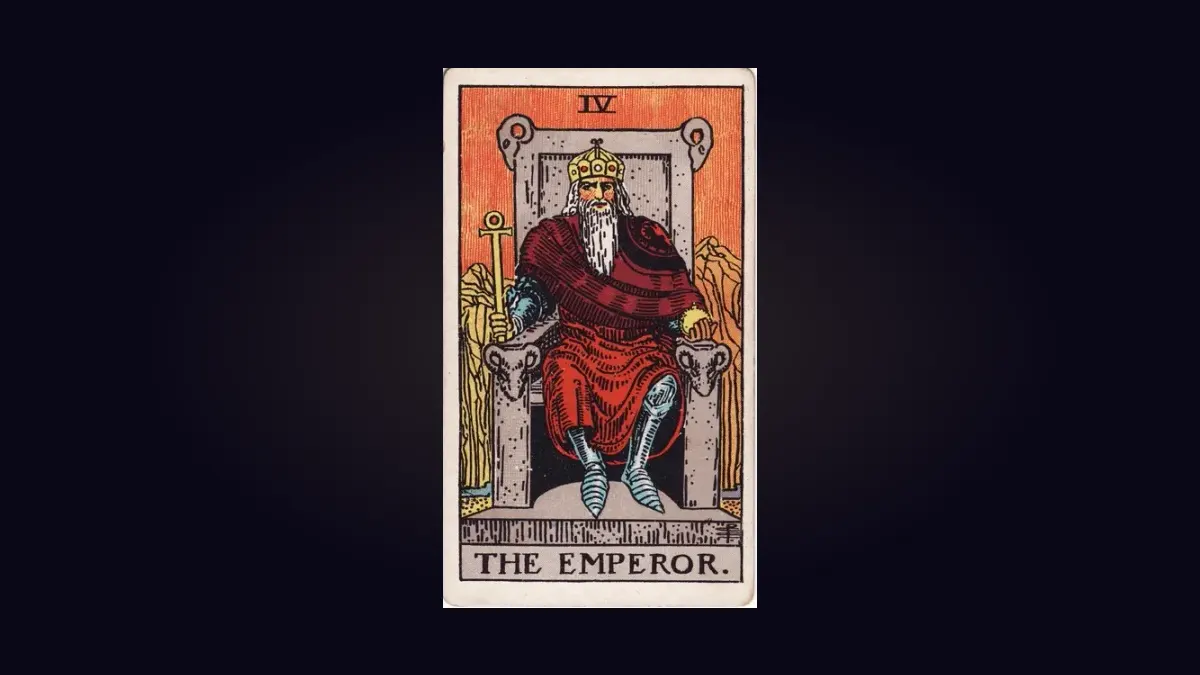
The Emperor is the fifth card of the Major Arcana — numbered IV, following The Empress — and the deck’s clearest signal for structural authority. A bearded ruler sits on a stone throne, holding an ankh and an orb, ram heads at the corners of his throne, red robes against a barren mountain backdrop. It is one of the most architecturally rigorous compositions in the Rider-Waite-Smith deck.
If you’ve drawn The Emperor in a recent reading and want the full upright and reversed reading along with position interpretations, this guide covers what the card actually means and why it isn’t patriarchy in the dismissive sense. (For context on the wider deck, our Tarot for beginners guide covers the 78-card structure. To do an actual draw, the Daily Tarot tool ships the full Rider-Waite-Smith deck.)
What does The Emperor card mean in tarot?
The Emperor (Major Arcana IV) in Rider-Waite-Smith tarot reads as structural authority — the willingness to take responsibility for a domain and hold it steady. The card is associated with leadership, stability, the architectural mind, the discipline to build something that outlasts the builder, and the readiness to set the rules rather than only follow them.
It is the card the tradition treats as the structural counterpart to The Empress’s nurturing creation.
The image — what’s actually on the card
Pamela Colman Smith’s 1909 illustration is the deck’s most architecturally rigorous portrait:
- A bearded ruler seated on a heavy stone throne — age and weight signal earned authority, not borrowed
- Four ram heads at the corners of the throne — Aries, the cardinal fire sign; the card is traditionally linked to Aries energy (initiative, leadership)
- An ankh in his right hand — the Egyptian symbol of life; authority that gives life rather than takes it
- A golden orb in his left hand — dominion held in balance with life
- Red robes over silver armour — the warrior beneath the king; the soldier learns the structure
- A barren mountain range behind him — the work is to bring order to hard ground, not pleasant terrain
- No green growth in the scene — unlike The Empress’s lush field, The Emperor’s domain is what he has organised, not what nature has given
Smith was a practising Golden Dawn member when she drew the deck; the rigid geometry of the throne and posture is deliberate.
The Emperor upright
The upright Emperor carries themes the tradition treats as cleanly structural:
- Authority taken — the willingness to be the one who decides, not just one who acts
- Stability — the conditions for things to last; rules, boundaries, consistent treatment
- Discipline — the architectural mind applied to time, work, and resources
- Father figure — not always literal; the archetype of protected structure
- Long-horizon thinking — building for years, not weeks
A.E. Waite’s Pictorial Key to the Tarot (1910) describes the card as “Stability, power, protection, realisation; a great person; a leader.” Smith’s illustration carries the gravitas Waite names without softening into harshness.
The Emperor reversed
The reversed Emperor is authority out of balance:
- Tyranny — control that has stopped serving the people it was built for
- Rigidity — structure that no longer adapts to what’s actually happening
- Refusal to lead — avoiding the responsibility the situation requires
- Power vacuum — when the throne is empty, the work scatters
- Authority issues — your own, or someone else’s; the card surfaces both
Most reversed Emperor readings are about the misuse of authority. The card reads the same direction either way; reversal just shows where the misuse has settled.
The Emperor in spread positions
In a Past / Present / Future spread (see our 3-card spread guide) the card reads differently in each slot:
- Past: an authority figure or structure that shaped what came after. Often a father, mentor, or institution; sometimes you in a role you’d forgotten.
- Present: the call to step into authority is live now. The card is asking whether you’ll take the role or keep deferring.
- Future: a leadership opening is approaching, or the consequences of an authority decision are landing.
In other layouts:
- Love position: the structural side of a partnership — commitment, reliability, the work of staying.
- Career position: leadership opportunity or the need to build/reinforce structure. Often a promotion signal.
- Outcome position: the answer involves stepping into responsibility, not stepping back from it.
- Advice position: “set the rule.” The card as advice usually means making the decision rather than waiting for permission.
Why The Emperor isn’t patriarchy (in the dismissive sense)
The card carries cultural weight that’s worth naming. “The Emperor” reads as patriarchal masculinity to modern eyes, and the bearded throne-sitter does little to soften that read. Combined with the gendered pairing (Empress/Emperor as III/IV), it’s easy to dismiss the card as outdated.
But the tradition’s deeper reading is structural rather than gendered:
- The Emperor is structural authority — not masculinity per se. Anyone of any gender takes the Emperor role when they hold a domain steady.
- The card pairs with The Empress, but doesn’t oppose her. Empress = generative creation; Emperor = organising structure. Both are needed in any project.
- The ram heads link the card to Aries — cardinal fire, the initiator. The Emperor is the energy of beginning something that will outlast the beginning.
- The mountain backdrop signals difficulty. Real authority isn’t pleasant; it’s the willingness to be responsible for hard ground.
Read this way, The Emperor is the deck’s permission card for taking authority over your own domain — your work, your home, your decisions — and holding it steady.
How to work with an Emperor draw
When the card shows up in a reading you actually care about:
- Step into the role. The card almost always means stopping the wait for someone else to lead.
- Set the rule. Decisions you’ve been deferring are part of what the card is naming.
- Build for time. Whatever you’re choosing should be designed to last.
- Notice where you’re already authority. The card sometimes surfaces a role you’re holding without acknowledging.
- Don’t soften unnecessarily. The Emperor’s edge is willingness to be unpopular when the structure requires it.
If you draw The Emperor and want to sit with a fuller reading — what to take charge of, what structure to build, what authority you’ve been avoiding — the Daily Tarot tool gives you the card and the traditional interpretation in one place.
A note on framing: tarot is offered here as a reflective practice, not a predictive tool. The Emperor is not foretelling a leadership promotion. It is naming a structural readiness you may already be carrying — and inviting you to use it.
Questions about this
Is The Emperor a good card in tarot?
Yes, with one caveat. The Emperor names the readiness to build structure and hold authority. For people whose work needs more structure, it's welcome. For people already over-structured, it can read as a warning. Most experienced readers treat it as a permission card — permission to take the role you've been avoiding.
What does The Emperor card mean in a love reading?
Stability, commitment, and the structural side of partnership — the part that endures over time. The Emperor in love rarely means romance in the dramatic sense; it means the choice to keep showing up. For singles, often signals a partner who values reliability over intensity.
What does The Emperor card mean reversed?
Reversed Emperor usually shows authority out of balance — either a refusal to step into responsibility, or rigid control that has stopped serving its purpose. Sometimes it points to authority figures whose grip is failing. The energy is the same; reversal shows the misuse.
What does The Emperor card mean in a career reading?
Structural leadership work — building or stewarding a system, role, or institution. The Emperor in career is often a green light on stepping into authority, especially when you've been hesitating. The shadow is rigidity; the gift is the spine the work needs.
What's the difference between The Emperor and The Hierophant?
The Emperor builds structure from his own authority. The Hierophant transmits structure from a lineage. Both sit in positions of power, but The Emperor's authority is self-generated and personal; The Hierophant's is inherited and communal. They follow each other in the sequence (IV and V) deliberately.
For reflection — not a prediction. Full disclaimer.