
The Hierophant Tarot Card Meaning (RWS) | Explain Fate
The Hierophant (Major Arcana V) in Rider-Waite-Smith tarot — upright and reversed meanings, positions, and why this card is the lineage you're heir to.
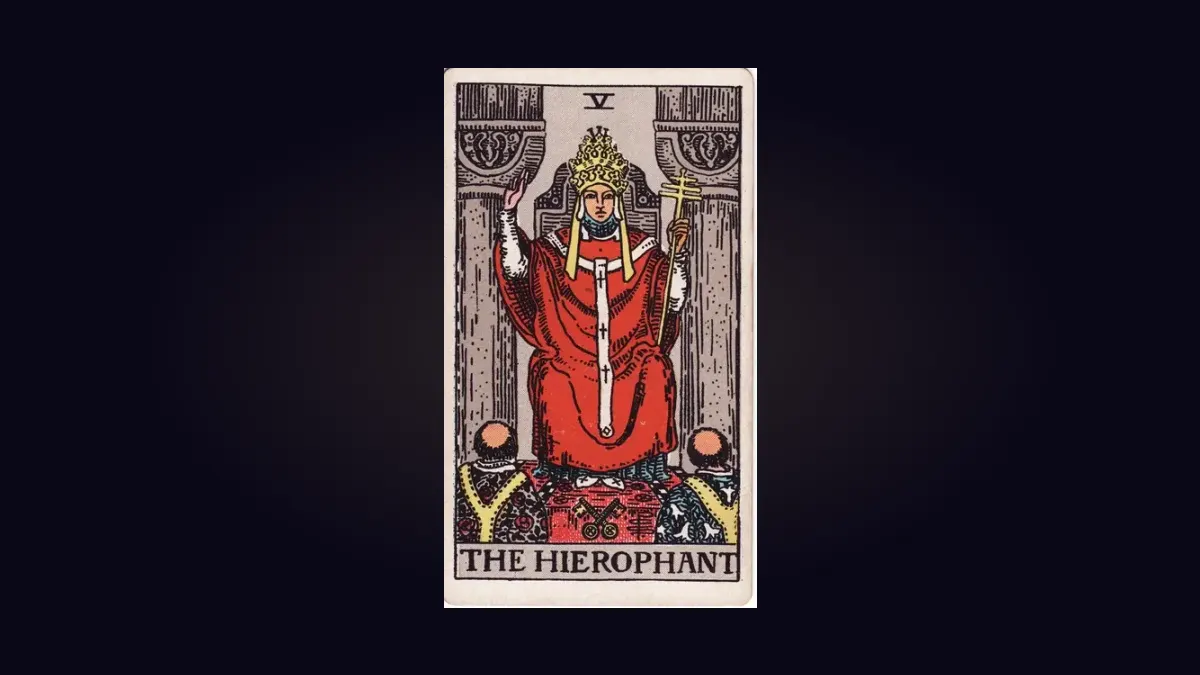
The Hierophant is the sixth card of the Major Arcana — numbered V, following The Emperor — and the deck’s clearest signal for transmitted tradition. A robed religious figure sits between two stone pillars, two acolytes kneeling before him, a triple-bar staff in his hand and crossed keys at his feet. It is one of the most explicitly religious compositions in the Rider-Waite-Smith deck.
If you’ve drawn The Hierophant in a recent reading and want the full upright and reversed reading along with position interpretations, this guide covers what the card actually means and why it isn’t just about organised religion. (For context on the wider deck, our Tarot for beginners guide covers the 78-card structure. To do an actual draw, the Daily Tarot tool ships the full Rider-Waite-Smith deck.)
What does The Hierophant card mean in tarot?
The Hierophant (Major Arcana V) in Rider-Waite-Smith tarot reads as inherited tradition — the structures, teachings, and lineages you didn’t invent but live inside. The card is associated with formal education, religious or spiritual institutions, mentorship, the transmission of accumulated wisdom, and the question of which inheritances to honour and which to set down.
It is the card the tradition treats as the bridge between The Emperor’s self-built authority and The Lovers’ personal choice.
The image — what’s actually on the card
Pamela Colman Smith’s 1909 illustration is the deck’s most overtly ecclesiastical:
- A robed figure seated between two stone pillars — the institutional setting; he speaks from inside a structure, not on a mountaintop
- A triple-bar staff in his hand — the papal cross; threefold authority over the spiritual, temporal, and personal domains
- A triple crown on his head — same threefold theme; the layered authority of inherited office
- Two acolytes kneeling before him — the transmission of teaching in action; he is mid-passing-on
- Crossed keys at his feet — the keys of heaven and earth; what the tradition can open
- Two stone pillars flanking him — like The High Priestess’s veil, but here the gateway is institutional rather than mysterious
Smith was a practising Golden Dawn member when she drew the deck; the Hierophant card translates the Catholic papal image into a more general “transmitter of tradition” archetype.
The Hierophant upright
The upright Hierophant carries themes the tradition treats as institutionally grounded:
- Inherited tradition — the wisdom you didn’t have to build because your tradition already built it
- Formal teaching — university, religious training, professional certification, mentorship
- Conventional structure — marriage, family roles, professional ethics, established practices
- Ritual and ceremony — the value of repeated forms; what becomes meaningful through repetition
- Spiritual guidance from a recognised source — clergy, therapist, established teacher
A.E. Waite’s Pictorial Key to the Tarot (1910) describes the card as “Marriage, alliance, captivity, servitude; mercy and goodness; inspiration.” Smith’s illustration extends this into something more specific: the question of which traditions are worth inheriting.
The Hierophant reversed
The reversed Hierophant is the lineage question turned active:
- Tradition rejected — sometimes appropriately, sometimes reactively
- Unconventional path — going your own way against what your community expects
- Heretical thinking — the position that the inheritance has gone wrong
- Personal spiritual practice over institutional — choosing the direct over the mediated
- Estrangement from a teaching lineage — by choice or by exile
Most reversed Hierophant readings are about the choice to step outside an inherited structure. The card reads the same direction either way; reversal just shows the dissent rather than the assent.
The Hierophant in spread positions
In a Past / Present / Future spread (see our 3-card spread guide) the card reads differently in each slot:
- Past: a teaching lineage or institutional structure that shaped you. Often parents, school, religious community, or a profession.
- Present: an inheritance question is live now. What do you keep, what do you set down?
- Future: a tradition is approaching that will ask you to choose — to step in or step out.
In other layouts:
- Love position: conventional partnership, family involvement, or the alignment of inherited values between partners.
- Career position: institutional work, credentialing, mentorship, or established-profession opportunities.
- Outcome position: the answer comes through tradition — a teacher, a structure, a way of doing things that’s been tested.
- Advice position: “honour the lineage.” The card as advice usually means learning the rules before breaking them.
Why The Hierophant isn’t just organised religion
The card’s explicitly Catholic imagery makes modern readers flinch. For many people, “tradition” carries the weight of structures that harmed them or whose authority they no longer accept. It’s tempting to dismiss the card as outdated religiosity.
But the tradition’s deeper reading is broader than any specific religion:
- The Hierophant is the architecture of inheritance — not just religious. Every tradition (artistic, professional, ancestral, cultural) has a Hierophant function.
- The keys at his feet open AND close. The lineage gives access to what’s accumulated, but it also marks what’s been excluded.
- The acolytes have different vestments. Smith painted the two kneeling figures with distinct symbolism — the lineage is plural; it includes branches, not just trunks.
- The card follows The Emperor and precedes The Lovers. Structurally, this is where inherited authority gets transmitted before personal choice begins. The order matters.
Read this way, The Hierophant is one of the most useful major arcana for adulthood — the card that asks which inheritances to honour, which to revise, and which to set down.
How to work with a Hierophant draw
When the card shows up in a reading you actually care about:
- Name the inheritance. Which tradition is the card pointing at? Sometimes obvious; sometimes a lineage you’d forgotten you live inside.
- Decide what to keep. The card rarely asks for wholesale rejection or wholesale acceptance — it asks for discernment.
- Find the teacher if you need one. The Hierophant honours formal learning; sometimes the right move is study, not improvisation.
- Notice where you’re already the teacher. For some, the card surfaces a lineage you’re transmitting without thinking about it.
- Don’t dismiss the conventional reflexively. Sometimes the inherited form is the right form, even if it’s unfashionable.
If you draw The Hierophant and want to sit with a fuller reading — what lineage, what teaching, what to inherit and what to set down — the Daily Tarot tool gives you the card and the traditional interpretation in one place.
A note on framing: tarot is offered here as a reflective practice, not a predictive tool. The Hierophant is not foretelling a religious turn. It is naming an inheritance question you may already be sitting with — and inviting you to answer it consciously.
Questions about this
Is The Hierophant a good card in tarot?
Mixed, depending on your relationship to tradition. For people seeking grounding in a lineage (spiritual, professional, ancestral), it's welcome. For people in active conflict with inherited structures, it can read as a friction signal. Most experienced readers treat it as an invitation to examine what you've inherited and choose what to keep.
What does The Hierophant card mean in a love reading?
Often signals conventional partnership — marriage, formal commitment, family-of-origin involvement. The Hierophant in love rarely means romance for its own sake; it names the structures around the partnership. Can also indicate values-shaped attraction (someone whose tradition aligns with yours).
What does The Hierophant card mean reversed?
Reversed Hierophant usually shows tradition rejected — sometimes appropriately (you've outgrown a lineage), sometimes prematurely (you've thrown out the structure before learning what it did). The energy is the same; reversal asks whether the rejection is wise or reactive.
What does The Hierophant card mean in a career reading?
Institutional or established-system work — universities, religious organisations, government, established professions. The Hierophant in career often points to credentialing, mentorship, or working within an existing structure rather than founding one (that's The Emperor).
What's the difference between The Hierophant and The Emperor?
The Emperor builds structure from his own authority. The Hierophant transmits structure from a lineage. The Emperor is self-generated; The Hierophant is inherited. They sit next to each other (IV and V) deliberately — most lasting structures need both: someone who builds and someone who teaches what was built.
For reflection — not a prediction. Full disclaimer.