
The Moon Tarot Card Meaning (RWS) | Explain Fate
The Moon (Major Arcana XVIII) in Rider-Waite-Smith tarot — upright and reversed meanings, positions, and why this card is the territory of dreams and intuition.
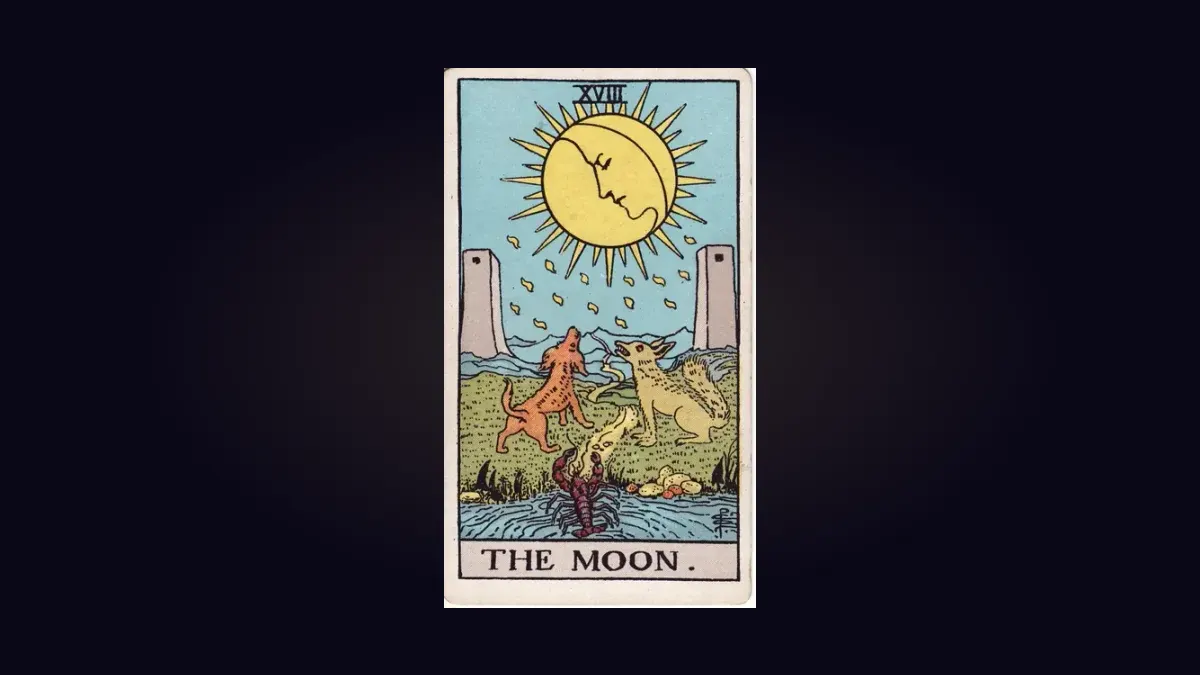
The Moon is the eighteenth card of the Major Arcana — and the deck’s clearest card for the territory of dreams, fears, and intuition. A path winds between two towers under a moon that has a face, a dog and a wolf bay at the sky, and a crayfish climbs from a pool at the bottom of the card. It is one of the most atmospheric cards in the Rider-Waite-Smith deck — uncomfortable, but not bad.
If you’ve drawn The Moon in a recent reading and want to know what the card actually means before reading too much menace into it, this guide covers the upright and reversed reading, the position-specific interpretations, and why the card is more teacher than warning. (For context on the wider deck, our Tarot for beginners guide covers the 78-card structure. To do an actual draw, the Daily Tarot tool ships the full Rider-Waite-Smith deck.)
What does The Moon card mean in tarot?
The Moon (Major Arcana XVIII) in Rider-Waite-Smith tarot reads as the territory of dreams, intuition, and the unconscious — the part of experience that is true but not yet spoken. The card is associated with illusion, fear, the unfamiliar path, and the work of walking forward without being able to see the end of the road.
It is one of the few major arcana that the tradition treats as deliberately ambiguous. The Moon does not resolve; it invites you to enter what hasn’t yet resolved.
The image — what’s actually on the card
Pamela Colman Smith’s 1909 illustration is the deck’s most layered nocturnal scene:
- A large moon with a human face, both a crescent and a full moon shown together — the moon as both phases at once, ambiguity literalised
- Fifteen yods falling from the moon — small flame-shaped drops, traditionally read as divine sparks reaching the unconscious
- A dog and a wolf baying at the sky — the tame and the wild parts of the psyche, both responding to the same signal
- Two towers flanking a path — gateposts at the threshold; the road continues past them
- A winding path through the centre — the unfamiliar way forward, leading toward distant mountains
- A crayfish climbing from a pool of water at the foot of the card — the deep unconscious surfacing, the most ancient part of mind emerging
- A pool in the foreground — the depths from which intuition rises
Smith was a practising Golden Dawn member when she drew the deck; the nocturnal symbolism is dense and deliberate. The card is structured as a journey card, not a static scene.
The Moon upright
The upright Moon carries themes the tradition treats as deliberately uncertain:
- Intuition — knowing without evidence; the small voice that arrives before the proof
- Dreams — both literal night-dreams and the dream-logic of the unconscious bleeding into waking life
- Fear — the kind that comes from not knowing; the discomfort of unfamiliar territory
- The unknown path — a road that has to be walked without a map
- Illusion — what looks true but isn’t; what looks false but is
A.E. Waite’s Pictorial Key to the Tarot (1910) describes the card as “Hidden enemies, danger, calumny, darkness, terror” — but Smith’s illustration is markedly less menacing than Waite’s words. Most modern readers (Rachel Pollack, Mary K. Greer) read The Moon as the territory of the unconscious rather than a warning.
The Moon reversed
The reversed Moon is the same energy beginning to reverse direction:
- Confusion lifting — the fog beginning to clear
- Fear giving way — the discomfort easing as the unfamiliar becomes familiar
- Truth surfacing — what was hidden becoming visible
- An illusion falling — recognising what was never true
- Awakening — coming out of the dream-state into clarity
Most reversed Moon readings are welcomed by experienced readers. The card reads the same direction either way; reversal just shows the tide turning toward visibility.
The Moon in spread positions
In a Past / Present / Future spread (see our 3-card spread guide) the card reads differently in each slot:
- Past: a confusing chapter you walked through. Often the reading is “you got through that without being able to see clearly the whole time” — a quiet acknowledgement.
- Present: the territory is unclear right now. The work is to trust intuition over analysis; the Moon period rewards patience.
- Future: an unfamiliar path is approaching. Not a warning — a preparation. The card is asking you to trust your reading of what cannot be proven.
In other layouts:
- Love position: unspoken truth, ambivalent feelings, or a phase that needs honest conversation before it can be read clearly.
- Career position: a phase where intuition matters more than the visible data; often before a pivot that hasn’t yet announced itself.
- Outcome position: the answer is unclear from where you are standing now. The card is honest about the obscurity.
- Advice position: “walk the path anyway.” The card as advice usually means going forward despite not being able to see the end.
Why The Moon isn’t deception
The card scares people because the imagery reads as ominous — night, baying dogs, a crayfish climbing from a pool, towers in shadow. The cultural association of the moon with madness (“lunacy”) doesn’t help. Beginners can over-read the card as a warning of betrayal.
But the tradition’s deeper reading is consistent across teachers:
- The Moon sits between The Star and The Sun in the sequence. The Star (XVII) is hope returning, The Moon (XVIII) is the night-passage where intuition is the only light, The Sun (XIX) is full emergence. The Moon is the middle of a three-card arc, not a terminus.
- The path continues past the towers. Smith painted the road going through the gateposts and on toward the mountains. The card is structured for forward movement.
- The yods from the moon are nourishment, not threat. The fifteen flame-drops are traditionally read as the unconscious being fed; the moon is giving, not taking.
- The crayfish is the oldest part of mind rising. It is allowed to come up. The card reads as integration — bringing the ancient material into awareness.
Read this way, The Moon is one of the more honest major arcana — the one that names what cannot yet be named and asks you to walk anyway.
How to work with a Moon draw
When the card shows up in a reading you actually care about:
- Don’t force clarity. The Moon period rewards waiting; pushing for resolution usually creates a worse one. Sleep on it.
- Trust the small signal. The card is about intuition. The thing you can’t fully articulate is often the most accurate read.
- Walk the path anyway. The Moon doesn’t ask you to stop; it asks you to keep going without certainty. Movement under unclear conditions is the card’s instruction.
- Notice your dreams. Many readers find that a Moon draw aligns with vivid or symbolic dreams in the same week. The unconscious is unusually communicative.
- Let the crayfish surface. Whatever ancient feeling is rising — old fear, old longing, old grief — the card is asking you to let it come up rather than push it back down.
If you draw The Moon and want to sit with a fuller reading — what’s unclear, what’s surfacing, what path you’re being asked to walk — the Daily Tarot tool gives you the card and the traditional interpretation in one place, and you can carry the focus question with you through the day.
A note on framing: tarot is offered here as a reflective practice, not a predictive tool. The Moon is not foretelling deception. It is naming a territory you may already be walking — and inviting you to trust the unclear signal until it clarifies on its own.
Questions about this
What does the moon card mean in tarot?
The Moon card (Major Arcana XVIII) means the territory of dreams, fears, and intuition — the unfamiliar path you walk before the sun rises. It is not a warning card in the traditional reading; it is the card of the unconscious territory you have to cross. Most modern readers treat The Moon as an invitation rather than a threat, even when the imagery is unsettling.
Is The Moon a bad card in tarot?
Not bad — uncertain. The Moon is the deck's card for the territory of dreams, fears, and intuition, which is uncomfortable but not negative. Most experienced readers treat it as an invitation to walk an unfamiliar path rather than a warning. Beginners often fear it; the tradition treats it as a teacher.
What does The Moon card mean in a love reading?
Often confusion or unspoken truth — feelings that are real but not yet clear, or a sense that something is off without being able to name it. The Moon in love rarely means betrayal; more often it means the conversation that hasn't happened yet. The card is asking what is true but not yet spoken.
What does The Moon card mean reversed?
Reversed Moon usually shows confusion lifting, fear giving way, or an illusion finally falling. The energy is the same as upright; reversal just shows the direction reversing — what was hidden is becoming visible. Many readers welcome a reversed Moon more than an upright one.
What does The Moon card mean in a career reading?
Uncertainty in the work itself, or a phase where intuition matters more than visible information. The Moon in career often shows up before a pivot, when something is shifting under the surface that hasn't reached the surface yet. The work is to trust the unclear signal.
What does The Moon card mean as a daily draw?
A day to listen rather than decide — dreams may be vivid, intuition may be loud, and the urge to force clarity is usually wrong. Many readers treat a Moon daily draw as permission to leave a decision overnight. The card rewards patience with confusion.
For reflection — not a prediction. Full disclaimer.