
The Star Tarot Card Meaning (RWS) | Explain Fate
The Star tarot card (Major Arcana XVII) — Waite's 'hope and bright prospects' read, upright + reversed positions, and why the card follows The Tower.
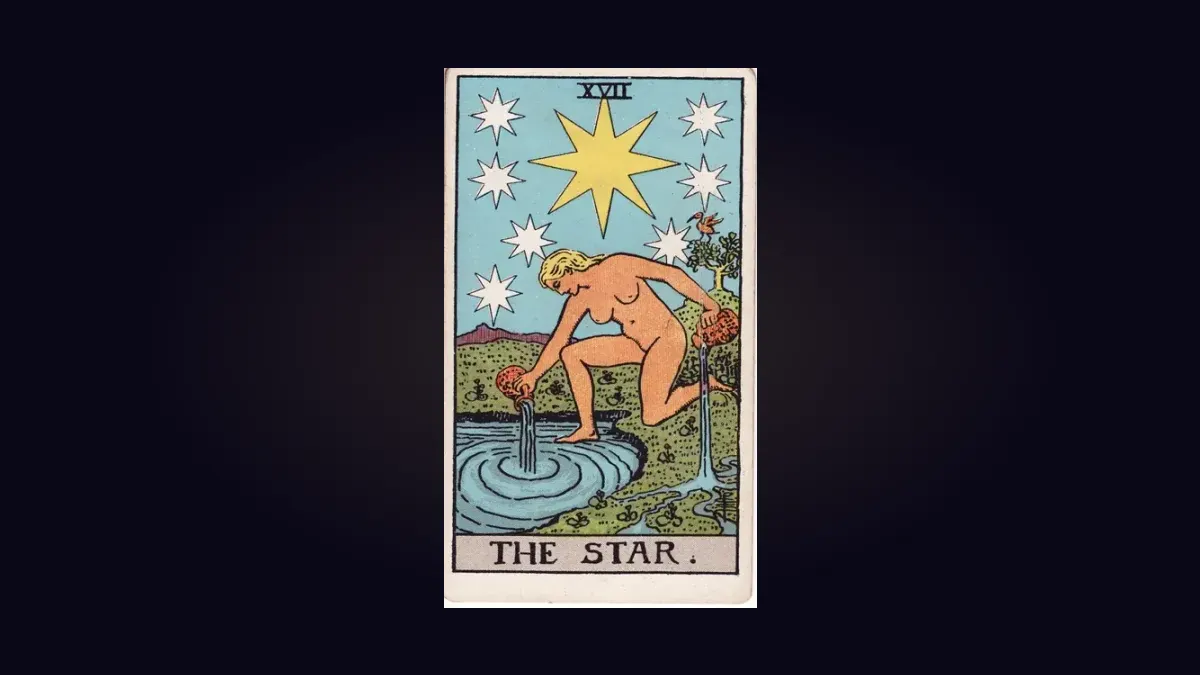
The Star is the seventeenth card of the Major Arcana — and the deck’s quietest moment of hope. A naked figure kneels by a pool, pouring water onto the land and back into the water, beneath a sky of eight stars. It is one of the most consistently soothing cards in the Rider-Waite-Smith deck, especially in a reading that has been difficult.
If you’ve drawn The Star in a recent reading and want the full upright and reversed reading along with position interpretations, this guide covers what the card actually means and why it carries weight beyond its gentle appearance. (For context on the wider deck, our Tarot for beginners guide covers the 78-card structure. To do an actual draw, the Daily Tarot tool ships the full Rider-Waite-Smith deck.)
What does The Star card mean in tarot?
The Star (Major Arcana XVII) in Rider-Waite-Smith tarot reads as hope and quiet renewal — faith returning after a hard passage, the slow replenishment of the well that has been drawn from. The card is associated with hope, serenity, inspiration, the patience of healing, and the trust that what you are doing matters even when you cannot see the outcome.
It is positioned in the sequence directly after The Tower (XVI), which gives the card its specific meaning: hope after upheaval, not naive optimism.
The image — what’s actually on the card
Pamela Colman Smith’s 1909 illustration is one of the deck’s most balanced compositions:
- A naked woman kneeling — openness without protection; the inner self exposed because the danger has passed
- One foot on land and one on water — the figure bridges the conscious and unconscious; the conditions of being human
- Two pitchers — water poured onto the land and back into the pool; the cycle of giving and receiving in balance
- A pool of water in front of her — the depths the figure has just emerged from
- Eight stars in the sky — one large central star and seven smaller ones; the cosmic order watching, the smaller stars often linked to the seven traditional planets
- A tree in the background with an ibis bird, associated with Thoth — wisdom returning, the inner knowing replenished
- Distant mountains — the long view, the perspective that hope requires
Smith was a practising Golden Dawn member when she drew the deck; the figure’s nakedness is a deliberate counter to the falling figures of The Tower — she is not falling but kneeling, choosing the openness.
The Star upright
The upright Star carries themes the tradition treats as gently restorative:
- Hope — the kind that returns after you stopped expecting it; quiet rather than triumphant
- Renewal — the slow refilling of what was emptied; not magical, just present
- Serenity — the calm that follows knowing the worst has passed
- Faith — trust that what you are doing matters, even without immediate evidence
- Inspiration — the still small voice returning, the creative well becoming available again
A.E. Waite’s own description, from the source text the deck is named for, is one of the shortest in the Pictorial Key:
“Hope and bright prospects.” — A.E. Waite, The Pictorial Key to the Tarot (1910), on The Star
Smith’s illustration deepens that four-word reading into something more earned: hope on the other side of having lost it. The phrase has become one of the most-quoted lines in the tarot tradition — a deliberate counter-weight to the doom-tinted readings of The Tower (XVI) that immediately precedes The Star in the sequence.
The Star reversed
The reversed Star is the same energy held just out of reach:
- Discouragement — the renewal hasn’t landed yet; the water feels far away
- Lost faith — temporarily, not permanently; the cycle is paused
- Depletion — the well that should be refilling isn’t, often because rest is being skipped
- Hopelessness — the dimmer version of the card; the stars are still there, harder to see
- Self-doubt about the practice — questioning whether the slow work matters
Most reversed Star readings are about reach rather than absence. The card reads the same direction either way; reversal just shows the distance between you and the water.
The Star in spread positions
In a Past / Present / Future spread (see our 3-card spread guide) the card reads differently in each slot:
- Past: a period of recovery that fed the present. Often a chapter you got through without recognising at the time how restorative it was.
- Present: quiet renewal is available right now. The work is to receive it slowly rather than rushing past it.
- Future: a healing phase is approaching, especially after difficulty. Not a sudden lift — a steady refilling.
In other layouts:
- Love position: a tender re-opening; faith in connection returning. The Star is rarely loud in love but is often the card that lets love land.
- Career position: a steady rebuild — clarity returning after confusion, purpose being remembered rather than rediscovered.
- Outcome position: the answer is hopeful but not yet manifest. The Star says yes; The Sun says fully visible.
- Advice position: “stay open.” The card as advice usually means receiving the rest you have been refusing.
Why The Star isn’t naive hope
The card can read as too gentle if you take it on first glance — pretty figure, soft colours, stars in the sky. New readers can dismiss it as a feel-good filler card and miss what makes it specific.
But the tradition’s deeper reading is consistent across teachers:
- The Star comes after The Tower. The two cards are paired in the sequence. The Star’s hope is not innocent; it follows collapse. The card is what’s available after you have stopped pretending the structure was fine.
- The figure is naked because the danger is over. Vulnerability is the texture of safety, not its opposite. The card reads as openness because protection is no longer needed.
- The water is being given back. The figure pours into both the land and the pool — what is received is returned. The Star’s hope is generative, not just personal.
- The ibis in the tree links to Thoth. Wisdom is part of the renewal; the card is not just emotional comfort but a return of clear thinking.
Read this way, The Star is one of the more grown-up major arcana — hope that has lived through losing hope and chosen to return.
How to work with a Star draw
When the card shows up in a reading you actually care about:
- Let it be quiet. The Star doesn’t ask for celebration; it asks for receiving. The work is slowing down enough to feel it.
- Notice what’s refilling. Often the renewal is already happening; the card is asking you to recognise it before you can name it.
- Trust the slowness. The Star is patient. Forcing the pace turns the card reversed.
- Pour into the land and the pool. What you are receiving is meant to flow outward as well; the figure’s posture is the instruction.
- Look at the stars. The card has a long view — the cosmic order is watching. The reading is asking you to remember the larger frame.
If you draw The Star and want to sit with a fuller reading — what is renewing, what is being replenished, what hope is reasonable — the Daily Tarot tool gives you the card and the traditional interpretation in one place, and you can carry the focus question with you through the day.
A note on framing: tarot is offered here as a reflective practice, not a predictive tool. The Star is not foretelling relief. It is naming a renewal you may already be in — and inviting you to receive it slowly.
Questions about this
What does the star card mean in tarot?
The Star card (Major Arcana XVII) means hope returning after a hard passage — quiet renewal, restored faith, and the slow refilling of what was emptied. It follows The Tower in the sequence, which is why the hope it carries is earned rather than naive. Most traditional readings treat The Star as one of the gentlest yes cards in the deck.
What did A.E. Waite say about The Star card?
A.E. Waite's Pictorial Key to the Tarot (1910), the source text the Rider-Waite-Smith deck is named for, describes The Star in just four words: 'Hope and bright prospects.' It is one of the shortest descriptions Waite gives any major arcana card. Pamela Colman Smith's illustration deepens that brief reading into something more earned — hope on the other side of having lost it.
Is The Star a good card in tarot?
Yes — it's one of the quietest yes cards in the deck. The Star follows The Tower in the major arcana sequence, which is why most readers treat it as the relief that follows hard change. It rarely promises easy outcomes; it promises that hope is reasonable. Most experienced readers welcome a Star draw without reservation.
What does The Star card mean in a love reading?
A gentle re-opening — faith in connection returning after a hard period, or a relationship slowly being replenished rather than dramatically renewed. For singles, often the season where hope becomes available again. The Star in love is rarely about a meeting; more often about a softening that makes meetings possible.
What does The Star card mean reversed?
Reversed Star usually shows discouragement or a temporary loss of faith — the well feels dry, the renewal hasn't landed yet. The energy of the card is the same; reversal just shows you can't quite reach the water. The hope isn't gone; it's harder to feel from where you're standing.
What does The Star card mean in a career reading?
Quiet recovery — clarity returning after a confusing period, or a renewed sense of purpose that may not be loud but is steady. The Star in career often shows up after a setback as the slow rebuild rather than the splashy comeback. The work is to trust the slowness.
What's the difference between The Star and The Sun?
The Star is hope returning after hard passage — quiet, faith-based, not yet visible to others. The Sun is full arrival — bright, visible, integrated. The Star comes after The Tower (XVI) as the first dawn; The Sun comes two cards later as midday. The Star is the trust; The Sun is the outcome.
For reflection — not a prediction. Full disclaimer.