
The Fool Tarot Card Meaning (RWS) | Explain Fate
The Fool tarot card meaning (RWS Major Arcana 0) — upright + reversed, positions, and which hand holds the rose in Smith's 1909 printing.
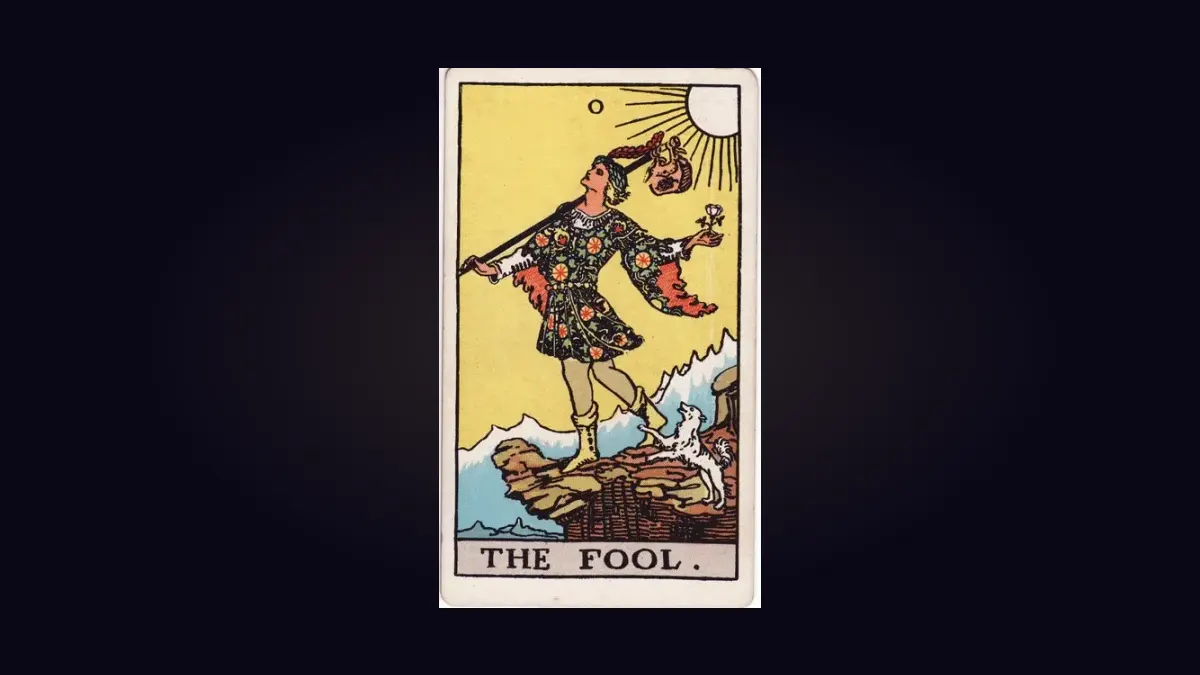
The Fool is the first card of the Major Arcana — numbered 0, standing at the start of the sequence — and the deck’s clearest signal for new beginnings. A young figure steps toward the edge of a cliff with a small bag over one shoulder, a white rose in hand, and a small dog at their feet. It is one of the most consistently encouraging cards in the Rider-Waite-Smith deck.
If you’ve drawn The Fool in a recent reading and want the full upright and reversed reading along with position interpretations, this guide covers what the card actually means and why the figure isn’t really foolish. (For context on the wider deck, our Tarot for beginners guide covers the 78-card structure. To do an actual draw, the Daily Tarot tool ships the full Rider-Waite-Smith deck.)
What does The Fool card mean in tarot?
The Fool (Major Arcana 0) in Rider-Waite-Smith tarot reads as new beginnings, the leap of faith, and the freedom that comes from not yet knowing how things turn out. The card is associated with openness, spontaneity, the open road, and the willingness to step toward what calls you before the map is finished.
It is the card the tradition treats as pure potential — the moment before anything has happened, when every direction is still available.
The image — what’s actually on the card
Pamela Colman Smith’s 1909 illustration is the deck’s clearest “beginning” composition:
- A young figure in bright clothing — youthful but not childish; the openness is chosen, not naive
- One foot stepping off the edge of a cliff — the leap forward is mid-motion; the card catches the instant of trust
- A small white rose in the left hand — purity of intention, the same flower carried by Death (XIII), connecting the two endpoints of the journey (why the left hand?)
- A small bag on a stick slung over the right shoulder — minimal baggage; the figure is travelling light
- A small white dog at the feet, often jumping up — the instinctual self alert and present, not asleep; some read it as a warning, others as a companion
- Distant mountains — the long view, the larger journey ahead
- A bright sun behind the figure — the favourable conditions; the leap happens in clear light, not in shadow
Smith was a practising Golden Dawn member when she drew the deck; the figure’s posture, the rose, and the dog are all deliberate. The Fool is not falling; the figure is mid-step, and the step is intentional.
Which hand holds the rose?
In Pamela Colman Smith’s canonical 1909 Rider-Waite-Smith printing, the white rose is held in the left hand. The right hand reaches back and up to carry the staff and small bundle slung over the right shoulder. This is consistent across the original 1909 Smith deck, the 1971 University Books reissue, and the modern US Games reproductions A.E. Waite commissioned.
Some mirror-flipped reprints reverse the orientation, but the authoritative Smith deck — the version Waite himself authorised — places the rose in the left hand. If your deck shows the rose in the right hand, it is almost certainly a flipped reproduction rather than the original Smith iconography.
The placement is symbolic, not incidental. Smith was a practising member of the Hermetic Order of the Golden Dawn when she drew the deck, and the Golden Dawn lineage assigns the left hand to receiving, intuition, and the inward-facing self, and the right hand to directing, action, and the outward-facing world. Read in that frame:
- The rose in the left hand is what The Fool is carrying — the pure intention, the receptive openness, the same flower Death (XIII) holds at the journey’s far end. The rose is the part of the leap that is protected.
- The staff and bundle in the right hand is what The Fool is bringing — the road, the small baggage that has been chosen rather than accumulated. The right hand is the practical side of the journey, raised behind the figure rather than pointed forward.
The hands name the same idea twice: openness held close, motion carried lightly. The detail rewards the close looker, but it is not a hidden teaching — it is what Waite and Smith painted on purpose.
The Fool upright
The upright Fool carries themes the tradition treats as freshly possible:
- Beginnings — a new chapter, a new project, a new way of being
- Leap of faith — choosing forward motion without complete information
- Innocence — not ignorance; the deliberate choice to approach with openness
- Spontaneity — responsiveness to what arises, rather than rigid planning
- The open road — the journey is the point; the destination is not yet visible
A.E. Waite’s Pictorial Key to the Tarot (1910) describes the card as “Folly, mania, extravagance, intoxication, delirium” — but Smith’s illustration carries almost none of that menace. Most modern readers (Rachel Pollack, Mary K. Greer) read The Fool as the soul’s open beginning, not as foolishness.
The Fool reversed
The reversed Fool is the energy out of balance — usually in one of two directions:
- Recklessness — leaping without listening; ignoring real warnings the upright Fool would still notice
- Refusing the step — hesitating at the edge when the step is exactly what’s wanted
- Naivety as a problem — openness that has become genuine blindness
- Foolishness in the unkind sense — choosing the lesson the hard way when an easier path is visible
- Avoiding responsibility — using “new beginnings” to flee what hasn’t been completed
Most reversed Fool readings are about miscalibration — either too much leap or too much hesitation. The card reads the same direction either way; reversal just shows which way the balance has tipped.
The Fool in spread positions
In a Past / Present / Future spread (see our 3-card spread guide) the card reads differently in each slot:
- Past: a beginning that shaped what came after. Often a leap you took without knowing where it would lead — and the current reading is benefiting from it.
- Present: a new beginning is live right now. The work is to take the step without waiting for guarantees.
- Future: a new chapter is approaching. The reading is usually permissive — the card is saying yes to whatever you are considering.
In other layouts:
- Love position: a new relationship or a fresh phase in an existing one; the willingness to be open without complete knowledge.
- Career position: a new role, a new direction, or the side-step that turns into the main road. Often a “yes” to the unconventional choice.
- Outcome position: the answer is to begin. The Fool in this slot is usually permission rather than caution.
- Advice position: “take the step.” The card as advice almost always means starting before you feel ready.
Why The Fool isn’t actually foolish
The card scares cautious readers because the imagery is literal — a figure about to walk off a cliff. The English word “fool” carries connotations of stupidity. Combined with the dog “warning” at the figure’s feet, beginners can read the card as a caution rather than an invitation.
But the tradition’s deeper reading is consistent across teachers:
- The Fool is numbered 0 — outside the sequence. The card is pure potential before any of the lessons have been met. Zero is not the absence of value; it is the open ground from which everything else proceeds.
- The figure is mid-step, not falling. Smith painted the foot lifted and forward, the head looking up. The body language is purposeful.
- The white rose is the same flower Death holds. The Fool and Death (XIII) bookend the journey of the soul; the rose carried at both ends signals continuity.
- The dog is a companion, not a warning. Read in context with the white rose and the bright sun, the dog reads as instinct alert and travelling alongside, not as a desperate alarm.
Read this way, The Fool is one of the deck’s most courageous cards — the willingness to begin without certainty, which the tradition treats as the precondition for any of the major arcana’s later wisdom.
How to work with a Fool draw
When the card shows up in a reading you actually care about:
- Take the step. The Fool’s instruction is almost always forward motion. Waiting for clarity often turns this card reversed.
- Travel light. The small bag is deliberate. The card is asking what you can leave behind rather than what you need to gather.
- Listen to the dog without obeying it. Instinctual caution is data; it’s not always the deciding factor. Notice it; choose freely.
- Don’t confuse the leap with recklessness. The upright Fool sees the cliff clearly. The leap is informed; it is just not certain.
- Look at the rose. Whatever you are choosing, the card is asking you to carry it with care — the openness is meant to remain pure even as the journey gets longer.
If you draw The Fool and want to sit with a fuller reading — what to begin, what to leave behind, what step is being asked — the Daily Tarot tool gives you the card and the traditional interpretation in one place, and you can carry the focus question with you through the day.
A note on framing: tarot is offered here as a reflective practice, not a predictive tool. The Fool is not foretelling success or failure. It is naming an opening that is in front of you — and inviting you to step into it with eyes open and hands light.
Questions about this
What does the fool card mean in tarot?
The Fool card (Major Arcana 0) means the soul's open beginning — the leap that has not yet calculated its landing, the moment of pure potential before form takes hold. Most traditional readings treat The Fool as the deck's clearest yes for new starts, especially the ones that scare you a little. The card stands at the very start of the major arcana sequence.
Is The Fool a good card in tarot?
Yes — it's the deck's clearest yes for new beginnings, especially ones that scare you a little. The Fool carries number 0 and stands at the start of the major arcana sequence, which the tradition reads as pure potential. Most experienced readers welcome a Fool draw, particularly at a decision point.
What does The Fool card mean in a love reading?
A new chapter — a new relationship, a fresh start within an existing one, or the willingness to be vulnerable in a way you haven't tried before. The Fool in love rarely warns; more often it permits. The card is asking whether you'll choose connection without all the answers.
What does The Fool card mean reversed?
Reversed Fool usually shows recklessness rather than openness — leaping without listening — or its opposite, hesitating at the edge when the step is exactly what's wanted. The energy is the same; reversal shows the imbalance. Either too much risk or too much hesitation, depending on the surrounding cards.
What does The Fool card mean in a career reading?
A new beginning — a new role, a new direction, a sideways move that opens unexpected territory. The Fool in career often shows up when the safer path is the wrong one. The card is asking what you'd choose if security weren't the deciding factor.
Why is The Fool card numbered 0?
The Fool stands outside the numbered sequence — pure potential before anything has happened. Some decks place the card at the start (0); some place it at the end (XXII). The card is the soul beginning the journey of the major arcana, before any of the lessons have been met. Zero is the open road.
Which hand holds the rose in The Fool tarot card?
In Pamela Colman Smith's canonical 1909 Rider-Waite-Smith printing, the white rose is held in the left hand. The right hand carries the staff with the small bundle over the right shoulder. Some mirror-flipped reprints reverse it, but the authoritative Smith deck — the version A.E. Waite commissioned — places the rose in the left.
For reflection — not a prediction. Full disclaimer.